
Abstract
Aim
The anatomical level of esophageal impaction plays a pivotal role in determining the optimal management strategy in children with foreign-body ingestion. In this context, we aimed to evaluate the clinical characteristics, management strategies, and outcomes of pediatric patients presenting with foreign-body ingestion to a tertiary-care pediatric emergency department, with particular emphasis on factors associated with the level of esophageal impaction.
Methods
This retrospective, single-center cohort study included 397 consecutive pediatric patients (0-18 years) evaluated for suspected foreign-body ingestion in the Pediatric Emergency Clinic of University of Health Sciences Türkiye, Basaksehir Cam and Sakura City Hospital between July 2020 and June 2024. Patient demographics, foreign body characteristics, anatomical level of esophageal impaction, management strategies, extraction techniques, and clinical outcomes were analyzed. Independent predictors of proximal esophageal impaction were identified using multivariable logistic regression, and the discriminatory performance of the final model was evaluated by receiver operating characteristic curve analysis.
Results
A total of 397 pediatric patients were included [220 males (55.4%), 150 females (37.8%); mean age, 49.1±42.5 months]. Children aged 12-36 months represented the largest age group (35.3%). Coins were the most frequently ingested foreign bodies (56.4%), and the cricopharyngeal region was the predominant site of esophageal impaction (63.5%). Although coin ingestion showed a higher rate of proximal impaction than other foreign bodies in univariate analysis (80.9% vs. 63.3%), the association did not reach statistical significance (p=0.053). After adjustment for potential confounders, coin ingestion [odds ratio (OR)=2.41, 95% confidence interval (CI): 1.52-3.82; p<0.001] and age ≤36 months (OR=1.68, 95% CI: 1.08-2.61; p=0.021) emerged as independent predictors of first physiological esophageal narrowing impaction. The multivariable model demonstrated acceptable discriminative performance (area under the curve =0.71, 95% CI: 0.65-0.77; p<0.001). Overall, successful extraction was achieved in 84.4% of patients, with an overall complication rate of 0.25%.
Conclusion
Younger age and coin ingestion independently predicted proximal esophageal impaction. The proposed model demonstrated acceptable discrimination and may support clinical decision-making in pediatric emergency practice.
Keywords: Foreign bodies, child, esophagus, endoscopy, emergency service
Introduction
Foreign body ingestion (FBI) is one of the most common pediatric emergencies in emergency departments worldwide and remains an important cause of urgent gastrointestinal intervention. The vast majority of cases occur in children younger than five years because of developmentally appropriate oral exploration, immature swallowing coordination, and limited hazard awareness. Although most ingested foreign bodies pass spontaneously through the gastrointestinal tract, esophageal impaction may lead to serious complications, including mucosal injury, ulceration, perforation, mediastinitis, and, in selected cases, life-threatening airway compromise. Contemporary international guidelines emphasize that management should be individualized according to four key factors: the type of ingested object, its anatomical location, the patient’s clinical condition, and the time elapsed since ingestion (-).
Coins remain the most commonly ingested foreign bodies in children, accounting for the majority of esophageal foreign-body presentations in many countries. Because coin dimensions vary across healthcare settings, local epidemiological data remain clinically important. The diameters of circulating coins in Türkiye range from 17.0 to 26.15 mm; this variation may influence the likelihood of esophageal impaction depending on the child’s age and esophageal caliber. The present data also indicates that the morphology, size, and anatomic orientation of the objects are risk factors for impaction, whereas button batteries, magnets, and sharp objects are associated with different management strategies owing to their significantly higher complication rates (,-).
The management of pediatric esophageal foreign bodies includes various therapeutic options, such as observation, Magill forceps extraction, Foley catheter retrieval, rigid esophagoscopy, and flexible endoscopy. Selection of the most appropriate intervention depends on the level of impaction, object characteristics, patient stability, and local expertise. Recent guideline updates recommend a structured, risk-based approach rather than the routine use of a single extraction technique and encourage individualized treatment algorithms to optimize procedural success while minimizing complications (,,,).
We hypothesized that coin ingestion and younger age are each independently associated with proximal esophageal impaction and that the anatomical level of impaction influences the choice of extraction technique in pediatric patients with FBI. Despite recent international guideline updates, evidence integrating foreign body characteristics, anatomical impaction patterns, and real-world extraction strategies in large pediatric emergency cohorts remains limited, particularly in countries with different coin dimensions in circulation. This study addresses this knowledge gap by evaluating the clinical characteristics, anatomical distribution, management strategies, and outcomes of FBI in children seen in a high-volume tertiary pediatric emergency department over five years.
Materials and Methods
Compliance with Ethical Standards
This study was conducted in accordance with the ethical principles of the Declaration of Helsinki and the Good Clinical Practice guidelines. Ethical approval was obtained from the University of Health Sciences Türkiye, Basaksehir Cam and Sakura City Hospital Clinical Research Ethics Committee (decision no: 301817582, date: 20.01.2026). Because of the retrospective study design and the use of anonymized patient data, the requirement for individual informed consent was waived by the Ethics Committee.
Study Design and Setting
This single-center retrospective observational study was conducted at the Pediatric Emergency Clinic of University of Health Sciences Türkiye, Basaksehir Cam and Sakura City Hospital, Istanbul, Türkiye, between July 1, 2020, and June 30, 2024.
Study Population and Data Collection
The study population comprised 397 pediatric patients, aged 0-18 years, who met predefined inclusion criteria and were evaluated for suspected foreign-body ingestion during the study period. Patient eligibility was assessed retrospectively according to predefined inclusion and exclusion criteria. Only patients with complete clinical documentation and sufficient data for analysis were included in the final study cohort. Patients were excluded for any of the following: tracheobronchial aspiration, incomplete medical records, previous gastrointestinal surgery, known gastrointestinal anomalies, neuromuscular disorders affecting swallowing, or transfer from another institution while receiving ongoing treatment.
Because this study was based on retrospectively collected institutional archival data, the total number of initially screened patients and the exact number of excluded cases in each exclusion category could not be reliably reconstructed. To avoid reporting potentially inaccurate numbers, only patients who fulfilled all predefined eligibility criteria and had complete, evaluable data were included in the final analysis. This methodological limitation has been explicitly acknowledged to ensure transparency in patient selection.
Medical records were systematically reviewed using the hospital’s information management system, including electronic patient records, emergency department logs, endoscopy reports, radiology reports, and discharge summaries. A standardized data collection form was used to extract demographic information (age, sex, age group), clinical parameters (foreign body type, level of esophageal impaction, extraction technique), and outcomes. Radiological images were reviewed via the hospital PACS system. Radiolucent foreign bodies were identified based on clinical history, physical examination findings, and endoscopic evaluation when available, particularly in cases where radiographic imaging was non-diagnostic.
Inclusion and Exclusion Criteria
Patients were included if they were aged 0-18 years, had documented FBI or a radiologically confirmed gastrointestinal foreign body, had complete medical records, and underwent at least one radiological imaging study. Exclusion criteria encompassed tracheobronchial aspiration, incomplete medical records, transfer from other institutions while receiving ongoing treatment, known gastrointestinal anomalies (esophageal stricture, achalasia, pyloric stenosis, and intestinal malrotation), prior gastrointestinal surgery, and neuromuscular disorders affecting swallowing function.
Outcome Measures
The primary outcome of the study was to identify factors associated with proximal esophageal impaction (first physiological narrowing), with particular emphasis on patient age and foreign body type.
The secondary outcomes included the anatomical distribution of impacted foreign bodies, the extraction techniques used according to the level of impaction, procedural success, complications, and overall clinical outcomes.
Statistical Analysis
Statistical analyses were performed using SPSS version 26.0 (IBM Corp., Armonk, NY, USA). Categorical variables were expressed as frequencies and percentages, while continuous variables were presented as mean ± standard deviation. The Kolmogorov-Smirnov and Shapiro-Wilk tests assessed the normality of the distribution. Categorical comparisons were performed using chi-square or Fisher’s exact tests, as appropriate. Multivariate binary logistic regression analysis was performed to identify independent predictors of proximal esophageal impaction (first narrowing vs. second/third narrowing). Variables considered clinically relevant and/or showing a univariate association with p<0.10 were selected as candidates for multivariable logistic regression. Results were expressed as odds ratios (ORs) with 95% confidence intervals (CIs). The discriminative performance of the logistic regression model was evaluated using receiver operating characteristic (ROC) curve analysis, with the area under the curve (AUC) calculated to assess model accuracy. An AUC of 0.7-0.8 was considered acceptable, 0.8-0.9 was considered excellent, and >0.9 was considered outstanding. Model calibration was assessed using the Hosmer-Lemeshow goodness-of-fit test. A two-tailed p-value below 0.05 was considered statistically significant. Object-specific variables, such as diameter, thickness, and morphology, were not included in the regression model to maintain model stability and avoid overfitting, given subgroup variability and incomplete data. Patient flow through eligibility assessment to final study inclusion is summarized in .
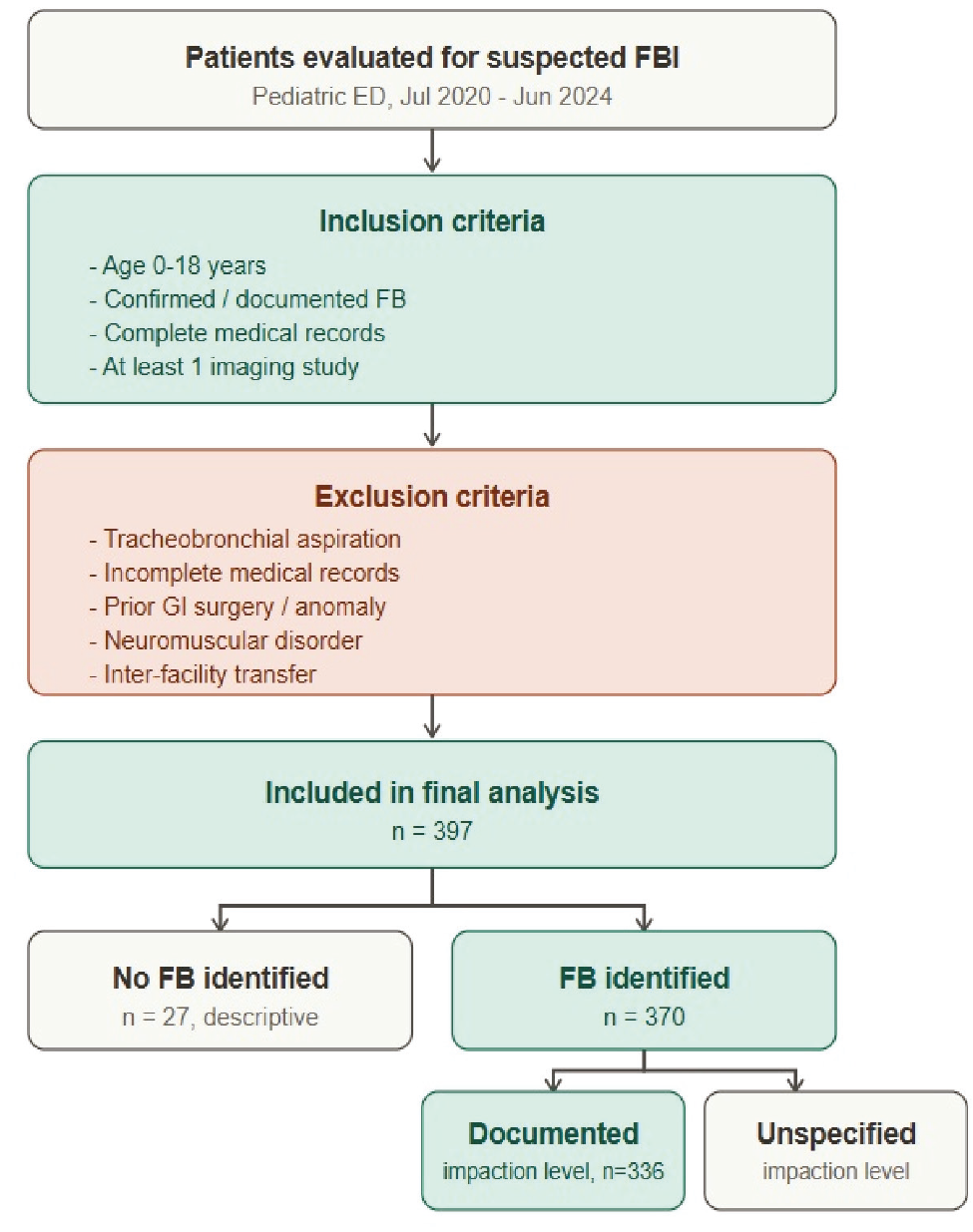
Study flow diagram of patient eligibility assessment and the final cohort (n=397), stratified by foreign body identification status. Screened/excluded numbers per criterion could not be reliably reconstructed from retrospective records
FBI: Foreign body ingestion, ED: Emergency department, GI: Gastrointestinal
Candidate variables for multivariable logistic regression included age group, sex, and foreign body type. Variables with a univariate p-value <0.10 were considered eligible for entry into the multivariable model. Object-specific variables, including coin denomination, object diameter, thickness, and morphology, were evaluated during model development but not entered into the final model because these data were incomplete or unavailable for several foreign body categories, resulting in substantial subgroup heterogeneity and an increased risk of model overfitting. Consequently, the final multivariable model included foreign body type (coin vs. non-coin), age group (≤36 vs. >36 months), and sex.
Results
Patient Demographics
Over the five-year study period, 397 pediatric patients were evaluated for FBI and included in the final analysis. Cases in which no foreign body was identified during the intervention (n=27) were included in descriptive analyses but excluded from comparative analyses examining relationships between foreign body type, impaction level, and extraction technique. The cohort comprised 220 males (55.4%) and 150 females (37.8%), and 27 cases (6.8%) with sex undocumented. The male-to-female ratio was 1.47:1. The mean patient age was 49.1±42.5 months (median: 36.0 months; range: 3-204 months). The 12-36-month age group accounted for the largest proportion of cases (140 patients, 35.3%), followed by the 36-60-month and 60-120-month groups (90 patients each, 22.7%) ().
Table 1. Demographic and clinical characteristics of patients (n=397)
Characteristic | n | % |
|---|---|---|
Sex | ||
Male | 220 | 55.4 |
Female | 150 | 37.8 |
Unknown | 27 | 6.8 |
Age group | ||
0-12 months | 32 | 8.1 |
12-36 months | 140 | 35.3 |
36-60 months | 90 | 22.7 |
60-120 months | 90 | 22.7 |
>120 months | 35 | 8.8 |
Esophageal impaction level | ||
First narrowing (cricopharyngeal) | 252 | 63.5 |
Second narrowing (aortic arch) | 52 | 13.1 |
Third narrowing (GEJ) | 32 | 8.1 |
Not specified/other | 50 | 12.6 |
Extraction technique | ||
Rigid esophagoscopy | 207 | 52.1 |
Magill forceps | 108 | 27.2 |
Foley catheter | 63 | 15.9 |
Flexible endoscopy | 17 | 4.3 |
Procedural outcome | ||
Successful extraction | 335 | 84.4 |
Advanced to stomach | 36 | 9.1 |
No foreign body identified | 27 | 6.8 |
GEJ: Gastroesophageal junction | ||
Types of Ingested Foreign Bodies
Coins were the predominant type of foreign body, accounting for 224 cases (56.4% of the total cohort). Among coin ingestions (calculated as percentages of the coin subgroup, n=224), 1 Turkish Lira coin (diameter: 26.15 mm) was the most common (69 cases, 30.8%), followed by 25 kurus coins (50 cases, 22.3%), 50 kurus coins (39 cases, 17.4%), 10 kurus coins (14 cases, 6.3%), and 5 kurus coins (11 cases, 4.9%). The specific denomination could not be determined in 42 cases (18.8% of the coin subgroup). Button batteries represented the second most common category (33 cases, 8.3% of total), followed by organic matter (23 cases, 5.8%), needles (15 cases, 3.8%), and jewelry items (14 cases, 3.5%) ().
Table 2. Types of ingested foreign bodies (n=397)
Foreign body type | n | % |
|---|---|---|
Coins (total) | 224 | 56.4* |
1 TL (26.15 mm) | 69 | 30.8† |
50 kurus (23.85 mm) | 39 | 17.4† |
25 kurus (20.5 mm) | 50 | 22.3† |
10 kurus (18.0 mm) | 14 | 6.3† |
5 kurus (17.0 mm) | 11 | 4.9† |
Unspecified denomination | 42 | 18.8† |
Button batteries | 33 | 8.3* |
Organic matter (meat, bone) | 23 | 5.8* |
Needles | 15 | 3.8* |
Jewelry (earrings, rings) | 14 | 3.5* |
Plastic/toys | 5 | 1.3* |
Magnets | 4 | 1.0* |
Other metallic objects | 25 | 6.3* |
No foreign body identified‡ | 27 | 6.8* |
*Percentage calculated from total cohort (n=397). †Percentage calculated from coin subgroup (n=224) ‡Cases with clinical suspicion but no foreign body found during intervention; included in descriptive analyses only TL: Turkish lira, mm: Millimeters
Esophageal Impaction Patterns
The anatomical distribution of impaction demonstrated a clear predominance at the first physiological narrowing (cricopharyngeal region), accounting for 252 cases (63.5% of the total). The second narrowing, at the level of the aortic arch, served as the impaction site in 52 cases (13.1%), while the third narrowing, at the gastroesophageal junction, was the impaction site in 32 cases (8.1%). The exact level was not specified in 50 cases (12.6%).
Relationship Between Foreign Body Type and Impaction Level
An initial univariate analysis of the relationship between foreign body type and impaction level revealed clinically noteworthy differences (χ2=12.422, p=0.053).
Among cases with documented impaction level (n=336, excluding those with unspecified location or no foreign body identified), coins exhibited the highest rate of impaction at the first narrowing (174/215, 80.9%), compared with those for needles (9/12, 75.0%), button batteries (19/30, 63.3%), and other objects (50/79, 63.3%). Conversely, button batteries and other objects had higher rates of impaction at the second narrowing (23.3% and 24.1%, respectively) than coins (11.2%) ().
Table 3. Relationship between foreign body type and esophageal impaction level (cases with specified impaction level only)
Foreign body type | First narrowing n (%) | Second narrowing n (%) | Third narrowing n (%) |
|---|---|---|---|
Coins (n=215) | 174 (80.9) | 24 (11.2) | 17 (7.9) |
Button batteries (n=30) | 19 (63.3) | 7 (23.3) | 4 (13.3) |
Needles (n=12) | 9 (75.0) | 2 (16.7) | 1 (8.3) |
Other objects (n=79) | 50 (63.3) | 19 (24.1) | 10 (12.7) |
Total (n=336) | 252 (75.0) | 52 (15.5) | 32 (9.5) |
Chi-square test, χ2=12.422, p=0.053. Cases with an unspecified location or with no foreign body identified were excluded
Multivariate Logistic Regression Analysis
To further investigate predictors of proximal esophageal impaction, a multivariate binary logistic regression analysis was performed with first-narrowing impaction as the dependent variable. Variables included in the model were foreign body type (coin vs. non-coin), age group (≤36 months vs. >36 months), and sex. The 36-month cutoff was selected based on clinical relevance—children in this age group represent the highest-risk population for FBI—and on the distribution of cases within the study cohort. After adjusting for confounding variables, coin ingestion emerged as an independent predictor of impaction at the first narrowing (OR=2.41, 95% CI: 1.52-3.82, p<0.001). Age ≤36 months was also significantly associated with proximal impaction (OR=1.68, 95% CI: 1.08-2.61, p=0.021), while sex showed no significant association (OR=1.12, 95% CI: 0.72-1.74, p=0.614). Sex was not independently associated with proximal impaction (). The Hosmer-Lemeshow test indicated adequate model fit (χ2=5.83, p=0.442) (). The ROC curve analysis demonstrated that the logistic regression model had acceptable discriminative ability, with an AUC of 0.71 (95% CI: 0.65-0.77, p<0.001). The optimal cutoff probability yielded a sensitivity of 68.3% and a specificity of 64.8% in predicting first narrowing impaction. These findings confirm that coins, with their flat, disc-like morphology that presents a larger cross-sectional area perpendicular to the esophageal lumen, are significantly more likely to lodge at the proximal esophageal narrowing than other foreign body types.
Table 4. Multivariate logistic regression analysis for predictors of first narrowing impaction
Variable | OR | 95% CI | p-value |
Coin (vs. non-coin) | 2.41 | 1.52-3.82 | <0.001 |
Age ≤36 months (vs. >36 months) | 1.68 | 1.08-2.61 | 0.021 |
Male sex (vs. female) | 1.12 | 0.72-1.74 | 0.614 |
Model fit: Hosmer-Lemeshow χ2=5.83, p=0.442. ROC analysis: AUC=0.71 (95% CI: 0.65-0.77), sensitivity 68.3%, specificity 64.8%. Bold p-values indicate statistical significance (p<0.05) OR: Odds ratio, CI: Confidence interval, ROC: Receiver operating characteristic, AUC: Area under the curve
Extraction Techniques and Outcomes
Rigid esophagoscopy was the most frequently employed technique (207 cases, 52.1%), followed by Magill forceps extraction (108 cases, 27.2%), Foley catheter retrieval (63 cases, 15.9%), and flexible endoscopy (17 cases, 4.3%). The relationship between impaction level and extraction technique was statistically significant (χ2=198.45, p<0.001). For impactions at the first narrowing, Magill forceps were most commonly employed (103/252, 40.9%), followed by rigid esophagoscopy (76/252, 30.2%) and Foley catheters (63/252, 25.0%). In contrast, impactions at the second narrowing were managed exclusively with rigid esophagoscopy (52/52, 100%), whereas impactions at the third narrowing predominantly required rigid esophagoscopy (29/32, 90.6%) or flexible endoscopy (3/32, 9.4%) (, ). Successful extraction was achieved in 335 cases (84.4%), while 36 cases (9.1%) involved intentional advancement into the stomach. One esophageal perforation (0.25%) required bilateral chest tube insertion. This patient recovered fully following an extended hospitalization.
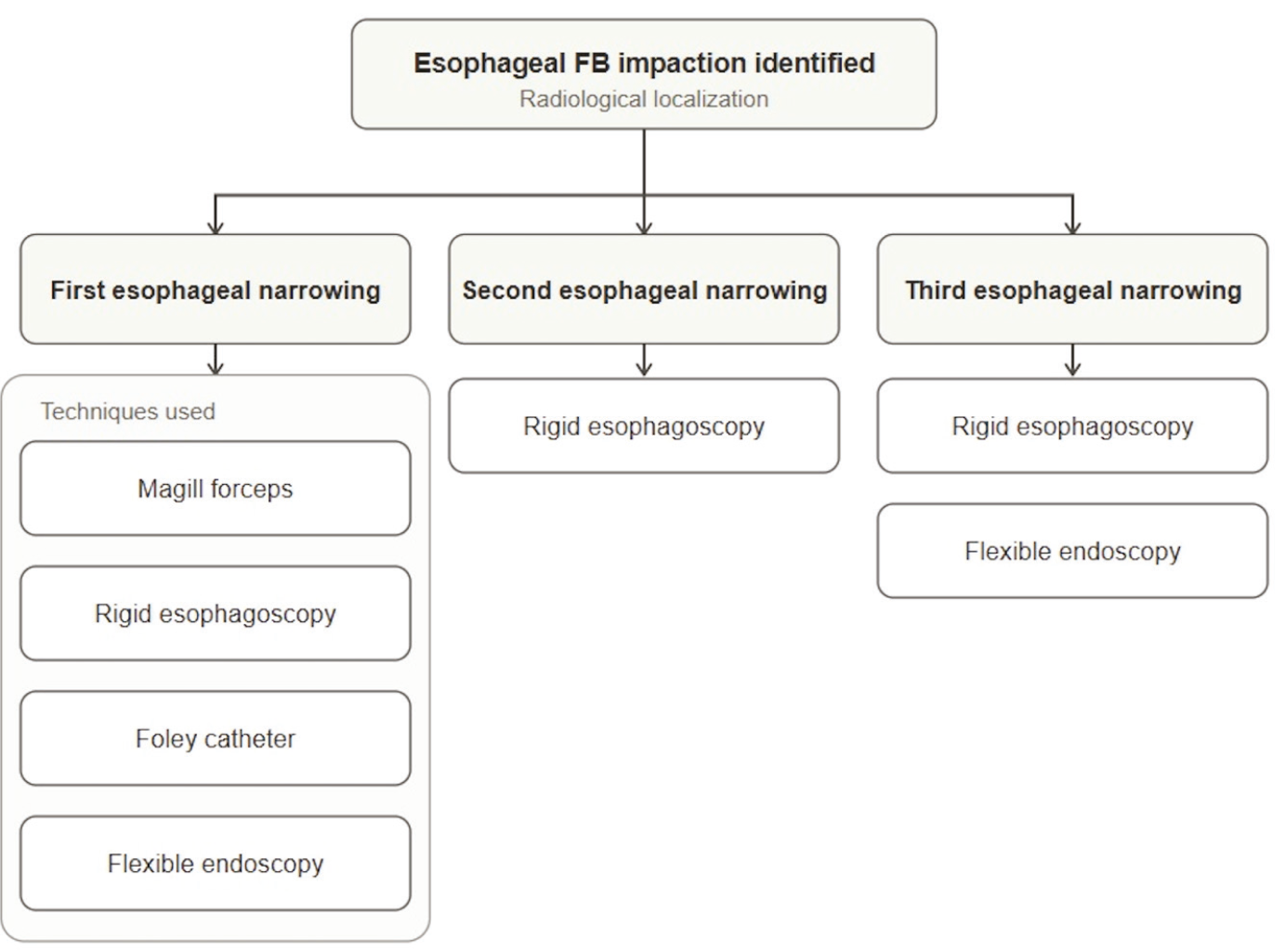
Management algorithm by esophageal narrowing level. Listed techniques are not sequential; selection is individualized based on object characteristics, patient stability, and institutional expertise
FB: Foreign body
Table 5. Relationship between esophageal impaction level and extraction technique
Impaction level | Rigid esophagoscopy n (%) | Magill forceps n (%) | Foley catheter n (%) | Flexible endoscopy n (%) |
First narrowing (n=252) | 76 (30.2) | 103 (40.9) | 63 (25.0) | 9 (3.6) |
Second narrowing (n=52) | 52 (100) | 0 (0) | 0 (0) | 0 (0) |
Third narrowing (n=32) | 29 (90.6) | 0 (0) | 0 (0) | 3 (9.4) |
Chi-square test, p<0.001. Cases with unspecified location (n=50) were excluded from this analysis | ||||
Discussion
This study provides an integrated evaluation of pediatric FBI in a high-volume, tertiary pediatric emergency department and demonstrates that patient age, foreign body characteristics, anatomical impaction site, and extraction strategy are closely interconnected in clinical management. Rather than merely describing the epidemiology of FBI, our findings identify clinically relevant factors associated with proximal esophageal impaction and support a structured, anatomy-based approach to selecting the most appropriate retrieval technique. These observations are consistent with recent international recommendations emphasizing that successful management depends on integrating patient characteristics with the type, location, and risk profile of the ingested object rather than relying on a single clinical parameter (,).
The demographic characteristics of our cohort were comparable to those reported in recent international studies. The predominance of male patients and the concentration of cases among children younger than 3 years are well recognized and are generally attributed to developmental oral exploration, immature swallowing coordination, and increased exposure to small household objects during early childhood (,,-). Recent international reviews have reinforced the epidemiology of FBI to show the influence of regional differences in household environments and the availability of commonly ingested objects, emphasizing the necessity of population-specific epidemiological data (,).
Coins remained the predominant ingested object in our cohort, consistent with contemporary pediatric series showing that coins continue to represent the most frequent gastrointestinal foreign body despite growing awareness of high-risk objects such as button batteries and magnets (,,,). Although current guidelines appropriately prioritize button battery ingestion because of the potential for rapid tissue injury, coin ingestion continues to generate a substantial proportion of pediatric emergency presentations (,,). The predominance of the 1 Turkish Lira coin in our population probably reflects local circulation and accessibility patterns, highlighting the importance of regional context when comparing foreign body distributions across countries (,).
One of the most clinically relevant observations was that coins tended to become impacted at the first physiological narrowing of the esophagus more frequently than other objects. This pattern is biologically plausible in the setting of esophageal anatomy and foreign body mechanics. Flat, circular objects may lie transversely in the relatively narrow cricopharyngeal segment, increasing resistance to spontaneous passage, whereas elongated or irregularly shaped objects may transit the proximal esophagus before lodging more distally. Although this association narrowly missed conventional statistical significance in the univariate analysis, the observed pattern is consistent with evidence suggesting that object morphology and anatomical location influence impaction behavior and subsequent therapeutic decision-making (,,).
The independent association between coin ingestion and proximal esophageal impaction after multivariable adjustment suggests that impaction risk is determined by the interaction between patient-related and object-related factors, rather than by foreign body type alone. Adjustment for age and sex strengthened the association observed in the univariate analysis, suggesting that age may have acted as an important confounding factor. Recent pediatric studies similarly indicate that anatomical maturation and foreign body characteristics jointly influence the location and clinical consequences of esophageal impaction (,).
This interpretation is also biomechanically plausible. The cricopharyngeal region is the narrowest physiological section of the esophagus in the pediatric population, and objects with relatively large transverse diameter and flat circular configuration are more likely to lodge at this level. Coins of approximately 20-26 mm may orient perpendicular to the esophageal lumen and therefore face increased resistance to spontaneous passage. Current pediatric literature supports the role of object dimensions, morphology, and anatomical constraints in proximal esophageal impaction.
Object-specific dimensions were not incorporated directly into the multivariable model because measurements were incomplete and heterogeneous across foreign body categories. Within this cohort, coin ingestion may nevertheless serve as a pragmatic surrogate marker for clinically relevant object size. Accordingly, these findings should be regarded as hypothesis-generating rather than as definitive evidence of causality. Prospective multicenter studies incorporating standardized measurements of object dimensions, symptom duration, and time to presentation may improve risk stratification and support the development of clinically applicable prediction models (,).
The significant association between the anatomical level of impaction and the extraction technique highlights the importance of tailoring management to the location of the foreign body rather than adopting a uniform therapeutic approach. At our institution, Magill forceps were preferred for objects impacted at the first physiological esophageal narrowing because this technique permits rapid removal under direct laryngoscopic visualization and may avoid more invasive procedures. Conversely, rigid esophagoscopy was preferred for distally impacted objects requiring controlled extraction under direct visualization. Foley catheter extraction represented an effective minimally invasive option for carefully selected patients with recently ingested, blunt, proximally located coins (,,).
Our management outcomes further support an anatomy-based treatment strategy. Selected blunt foreign bodies were intentionally advanced into the stomach when doing so was considered safer than retrieval. Current guidelines recommend balancing the risks of intervention against the likelihood of spontaneous gastrointestinal passage, particularly for blunt objects that have passed beyond the upper esophageal sphincter and do not have high-risk characteristics (,).
The low complication rate in our cohort supports the potential safety of individualized management, based on foreign body characteristics and anatomical location, in experienced pediatric centers. Recent studies and guideline-based reviews suggest that overall treatment safety, procedural success, and the need for additional intervention should be considered together when evaluating management outcomes (,,,). Our findings are consistent with these principles and support the use of structured, guideline-informed management algorithms in routine clinical practice.
We report the epidemiological features of this study and provide an integrated clinical perspective that examines correlations among patient age, foreign body morphology, anatomical impaction patterns, and procedural decision-making. These findings may help clinicians identify children at higher risk of proximal esophageal impaction and select an appropriate extraction technique. Prospective multicenter studies including standardized morphological measurements and relevant temporal variables are required to refine risk stratification and further individualize management.
Study Limitations
This study has several limitations. First, its retrospective, single-center design may limit the generalizability of the findings. Second, some clinically relevant variables, including symptom duration, time from ingestion to presentation, and detailed measurements of all foreign body dimensions, were not consistently available because of the retrospective nature of the study. Third, object-specific dimensions were not incorporated into the multivariable regression model because of subgroup heterogeneity and incomplete measurements; this omission may have influenced the observed associations. The study reflects the experience of a tertiary pediatric emergency department and therefore may not be directly applicable to institutions with different patient populations or management protocols.
Despite these limitations, this study has several important strengths. It represents one of the largest recently reported single-center pediatric foreign-body ingestion cohorts from Türkiye and provides a comprehensive evaluation of patient demographics, foreign-body characteristics, anatomical impaction patterns, extraction techniques, and clinical outcomes over a five-year period. In addition, the integration of epidemiological findings with biomechanical interpretation and multivariable analysis offers clinically relevant insights that may facilitate individualized management and guide prospective studies.
Conclusion
In conclusion, younger age and coin ingestion were identified as independent predictors of proximal esophageal impaction in children with foreign-body ingestion. These readily available clinical factors may facilitate early risk stratification and support individualized management based on patient age, foreign-body morphology, and anatomical location, rather than on the type of ingested object alone. In our cohort, coins measuring approximately 20-26 mm were more frequently associated with proximal esophageal impaction, suggesting that object diameter may also contribute to impaction risk, particularly in younger children.
An anatomy-based treatment strategy may optimize procedural planning and clinical outcomes. Magill forceps may be considered the preferred first-line technique for foreign bodies impacted at the first physiological esophageal narrowing when adequate visualization is achieved, whereas Foley catheter extraction may serve as a minimally invasive alternative in carefully selected patients. Rigid esophagoscopy remains the gold standard for distally impacted foreign bodies. Overall, applying these anatomy-based principles may improve the selection of extraction techniques, reduce unnecessary invasive procedures, and maintain high procedural success with minimal morbidity. The proposed model demonstrated acceptable discrimination and may support clinical decision-making in pediatric emergency practice. Prospective multicenter studies are warranted to validate these findings and further refine evidence-based management strategies.
Ethics
Ethics Committee Approval: This study was approved by the University of Health Sciences Türkiye, Basaksehir Cam and Sakura City Hospital Clinical Research Ethics Committee (decision no: 301817582, date: 20.01.2026). Ethics approval was obtained retrospectively because the study had a retrospective design and used anonymized patient data.
Informed Consent: Individual informed consent was waived due to the retrospective study design.
Footnotes
Authorship Contributions
Surgical and Medical Practices: M.N.S., A.B., F.S., Concept: M.N.S., A.B., F.S., B.A., Design: M.N.S., Data Collection or Processing: A.B., B.B.O., Analysis or Interpretation: M.N.S., F.S., Literature Search: M.N.S., A.B., F.S., B.A., Writing: M.N.S., F.S., B.A.
Conflict of Interest
The authors declared that there were no conflicts of interest.
Financial Disclosure
The authors declared that this study received no financial support.
References
Ledder O, Furlano R, Papadopoulou A, et al. Foreign body ingestions in children and adolescents: a position paper of the European Society for Pediatric Gastroenterology, Hepatology, and Nutrition (ESPGHAN) endoscopy special interest group. J Pediatr Gastroenterol Nutr. 2026;83:539-54.
Stone DE, Lembo BC. Foreign body ingestion and aspiration. Pediatr Rev. 2026;47:352-5.
Expert Panel on Pediatric Imaging; Meyers ML, Moore MM, Baker JB, et al. ACR appropriateness criteria® ingested or aspirated foreign body-child. J Am Coll Radiol. 2026;23:732-47.
Rogalidou M. Ingestion of foreign bodies and caustic substances in children: a narrative review on clinical evaluation and management update. Clin Exp Pediatr. 2026;69:11-21.
Li Z, Yang C, Duan J, et al. Clinical experiences of 109 children with foreign body ingestion: a retrospective study from Kunming, China. Front Pediatr. 2026;14:1771328.
Xue N, Wei X, Xu J, Zhu L. High-risk foreign body ingestion in children: clinical features and endoscopic outcomes. Front Pediatr. 2026;14:1832241.
Nugud AA, Tzivinikos C, Assa A, et al.; Gastrointestinal Committee of ESPGHAN. Pediatric magnet ingestion, diagnosis, management, and prevention: a European Society for Paediatric Gastroenterology Hepatology and Nutrition (ESPGHAN) position paper. J Pediatr Gastroenterol Nutr. 2023;76:523-32.
Kramer RE, Lerner DG, Lin T, et al.; North American Society for Pediatric Gastroenterology, Hepatology, and Nutrition Endoscopy Committee. Management of ingested foreign bodies in children: a clinical report of the NASPGHAN Endoscopy Committee. J Pediatr Gastroenterol Nutr. 2015;60:562-74.
Di Siena A, Melli P, Rodofile F, et al. Foreign body ingestion in children: a 16-year experience. Pediatr Gastroenterol Hepatol Nutr. 2025;28:215-23.
Pereira LDM, Barreira MA, de Saboia Mont’Alverne TN, et al. Endoscopic techniques and factors for complications in pediatric esophageal foreign body removal. World J Gastrointest Endosc. 2025;17:106352.
Manfredi MA, Alvarez RP, Arai K, et al. Global insights on the diagnosis, management, and prevention of pediatric ingestions: a report from the FISPGHAN expert panel. JPGN Rep. 2025;6:274-87.
Yeon HJ, Lee SM, Ihn K, Oh JT, Han SJ, Ho IG. Pediatric foreign body ingestion: analysis of patient characteristics and surgical treatment. Children (Basel). 2025;12:1355.
Erginel B, Kaba M, Karadag CA, Yildiz A, Demir M, Sever N. Foley catheter technique for the extraction of coins lodged in the upper esophagus of children. BMC Pediatr. 2023;23:605.
Kasakanga K, Groenewald A, Mabitsela ME, Tshifularo N. A retrospective review of the management of impacted coin ingested in children. Afr J Paediatr Surg. 2025;22:32-7.
Hashimi B, Shaffer AD, McCoy JL, Chi DH, Padia R. Resource utilization and risk factors for esophageal injury in pediatric esophageal foreign bodies. Laryngoscope. 2024;134:4774-82.
Demiroren K. Management of gastrointestinal foreign bodies with brief review of the guidelines. Pediatr Gastroenterol Hepatol Nutr. 2023;26:1-14.