
Abstract
Aim: Depression and sleep disturbances are common but often overlooked complications in patients with liver cirrhosis. We aimed to determine the prevalence of anxiety, depression, and sleep disturbances in patients with liver cirrhosis and to investigate their association with disease severity.
Methods: This cross-sectional study enrolled 115 patients with cirrhosis and 207 healthy volunteers, all recruited between October 2022 and June 2023. Sociodemographic characteristics (age, gender, marital status, smoking and alcohol use, income, and education level), medical history, and laboratory findings were recorded. Disease severity was evaluated using the Child-Pugh and MELD-Na scoring systems. The Hospital Anxiety and Depression Scale (HADS) and the Pittsburgh Sleep Quality Index (PSQI) were used to assess anxiety, depression, and sleep disturbances. Statistical comparisons were performed using the Mann-Whitney U test, the chi-square test, and the Spearman correlation analysis.
Results: Patients with liver cirrhosis had significantly higher median HADS-Anxiety scores [13 (8-17) vs. 5 (4-7), p<0.001], HADS-Depression scores [12 (9-16) vs. 4 (3-6), p<0.001], and PSQI scores [11 (6-14) vs. 5 (4-7), p<0.001] compared with controls. Anxiety was present in 64.3% of patients versus 3.4% of controls (p<0.001); depression in 66% of patients versus 1.9% of controls (p<0.001); and poor sleep quality in 85.2% of patients versus 47.8% of controls (p<0.001). Significant positive correlations were observed between HADS-Anxiety and MELD-Na scores and between HADS-Depression and PSQI scores and both MELD-Na and Child-Pugh scores. No statistically significant correlation was found between HADS-Anxiety and Child-Pugh scores (p=0.056).
Conclusion: Anxiety, depression, and sleep disturbances are highly prevalent among patients with cirrhosis and are associated with disease severity. Routine psychological assessment and timely intervention may improve patients’ quality of life and clinical outcomes.
Keywords: Cirrhosis, depression, sleep-wake disorders, anxiety
Introduction
Liver cirrhosis is a chronic and progressive condition that represents the final stage of various liver diseases, including chronic alcohol use, viral hepatitis, autoimmune liver disorders, and other etiologies. It is characterized by persistent liver injury and fibrotic tissue formation, which disrupt normal liver function. Cirrhosis is associated with high morbidity and mortality worldwide, and patients experience frequent hospitalizations, polypharmacy, invasive procedures, and a substantial reduction in quality of life (). Psychological comorbidities, particularly anxiety and depression, are common in patients with cirrhosis and may contribute to disease progression and adverse clinical outcomes (,). Recent evidence highlights that these psychiatric comorbidities significantly influence disease burden and patient-reported outcomes in cirrhosis (). Sleep disturbances are also prevalent among patients with cirrhosis, further contributing to impaired daily functioning and reduced overall well-being (,). Recent studies indicate that cirrhosis may directly impair sleep quality through complex pathophysiological mechanisms and is associated with worsened prognosis and quality of life ().
Although the relationship between liver cirrhosis and depression is well recognized, few studies have simultaneously assessed anxiety, depression, and sleep disturbances in this population. Previous studies have primarily focused on individual symptoms or specific etiologies such as hepatitis B-related cirrhosis (-). Comprehensive investigations examining the interaction between these psychological factors and disease severity, including MELD-Na and Child-Pugh scores, are limited. Recent studies suggest that disease severity indices such as MELD-Na are associated with both physical and psychological outcomes in cirrhosis (). We hypothesized that patients with liver cirrhosis would have higher rates of depression, anxiety, and sleep disturbances than healthy individuals, and that these conditions would correlate with liver disease severity.
While several studies have addressed psychological symptoms in chronic liver disease, most have examined either depression or sleep disturbances. Studies that evaluate anxiety, depression, and sleep quality together and their association with disease severity in patients with cirrhosis remain scarce. Therefore, further studies are warranted to clarify the combined impact of these psychological and behavioral factors on the clinical course of cirrhosis. Emerging evidence also emphasizes the role of psychological distress and resilience in shaping health-related quality of life in patients with liver cirrhosis (). A recent systematic review and meta-analysis also confirmed that anxiety and depression are highly prevalent among patients with liver cirrhosis, emphasizing the importance of routine psychological assessment in this population (). Accordingly, this study was designed to assess the prevalence of anxiety, depression, and sleep disturbances in patients with liver cirrhosis and to investigate their association with disease severity. Understanding these associations may facilitate the early identification of patients at increased psychological risk and support more comprehensive clinical assessment.
Materials and Methods
Compliance with Ethical Standards
Ethical approval for this study was obtained from the Clinical Research Ethics Committee of the University of Health Sciences Türkiye, Sancaktepe Sehit Prof. Dr. Ilhan Varank Training and Research Hospital (approval date: September 14, 2022; approval no: 114).
Study Design and Participants
This study was conducted in accordance with the principles of the Declaration of Helsinki. Written informed consent was obtained from all participants prior to inclusion in the study.
A total of 115 adult patients with liver cirrhosis and 207 healthy volunteers were enrolled in the study. Cirrhosis was confirmed based on clinical, laboratory, histological, and radiological findings. All participants received detailed information about the study and provided written informed consent. Sociodemographic data, including age, gender, marital status, smoking and alcohol habits, income level, and educational level, were recorded.
Inclusion and Exclusion Criteria
Adult patients with confirmed liver cirrhosis and healthy volunteers without known chronic diseases or substance use were included in the study. Participants with cerebrovascular disease or cerebral trauma, with recent hepatic encephalopathy or receiving treatment for hepatic encephalopathy, with psychiatric comorbidities, with known sleep disorders, who used central nervous system-acting medications, who were unable to complete the questionnaires, or who refused to provide informed consent were excluded.
Assessments
Clinical and Laboratory Evaluation: Routine clinical examinations, medical history, medication use, and laboratory parameters were recorded. Disease severity was assessed using the Child-Pugh classification and the MELD-Na score.
Psychological Assessment: Anxiety and depression were assessed using the Hospital Anxiety and Depression Scale (HADS). HADS scores were categorized as ≤7 (normal), 8-10 (borderline), and ≥11 (abnormal). Sleep quality was evaluated using the Pittsburgh Sleep Quality Index (PSQI). A global PSQI score ≥5 indicated poor sleep quality.
The overall study design, participant selection process, clinical and psychological assessments, and statistical analyses are summarized in .
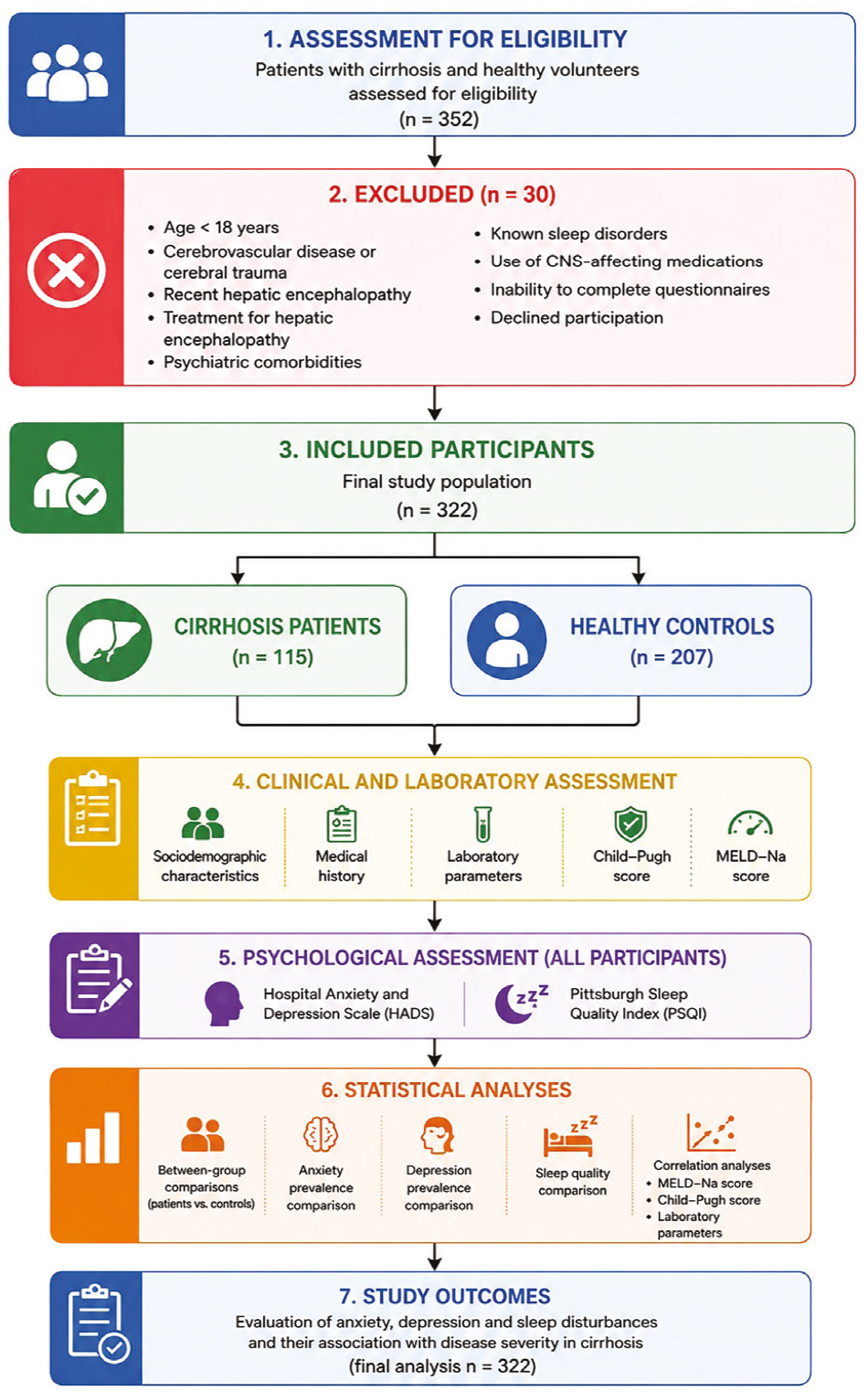
Flow diagram of the study design, participant selection, assessments and statistical analyses
HADS: Hospital Anxiety and Depression Scale, PSQI: Pittsburgh Sleep Quality Index, MELD-Na: Model for End-Stage Liver Disease-Sodium
Statistical Analysis
Statistical analyses were performed using IBM SPSS Statistics for Windows, version 25.0 (IBM Corp., Armonk, NY, USA). Continuous variables are presented as mean ± standard deviation (SD) or median [interquartile range (IQR)], as indicated in the tables. Categorical variables are presented as counts and percentages. Independent-samples t-tests were used to compare age between patients with cirrhosis and healthy controls and to compare HADS-Anxiety, HADS-Depression, PSQI, MELD-Na, and Child-Pugh scores between patients with decompensated and compensated cirrhosis. The Mann-Whitney U test was used to compare HADS-Anxiety, HADS-Depression, and PSQI scores between patients with cirrhosis and healthy controls. Categorical variables were compared using the chi-square test. Correlations were assessed using Spearman’s rank correlation. A two-sided p-value <0.05 was considered statistically significant.
Results
A total of 322 participants were included in the study, comprising 115 patients with liver cirrhosis and 207 healthy controls. No significant differences between the groups were observed with respect to age, sex, marital status, income level, or educational level (all p>0.05, ).
Table 1. Comparison of sociodemographic data of patients with liver cirrhosis and control groups
Variable | Cirrhosis group (n=115) | Healthy controls (n=207) | p |
|---|---|---|---|
Age (year) | 62.42±12.00a | 60.02±13.70a | 0.051b |
Sex | |||
Male (n=168) | 62 (36.90%) | 106 (63.10%) | 0.641c |
Female (n=154) | 53 (34.40%) | 101 (65.60%) | |
Income level | |||
Below minimum wage (n=91) | 33 (35.60%) | 58 (64.40%) | 0.622c |
Minimum wage (n=98) | 38 (38.80%) | 60 (61.20%) | |
Above minimum wage (n=133) | 44 (32.60%) | 89 (67.40%) | |
Marital status | |||
Single (n=129) | 51 (44.30%) | 78 (37.70%) | 0.242c |
Married (n=193) | 64 (55.70%) | 129 (62.60%) | |
Education level | |||
Illiterate (n=52) | 19 (16.50%) | 33 (15.90%) | 0.131c |
Primary school (n=87) | 39 (34.80%) | 48 (23.20%) | |
High school (n=90) | 29 (24.30%) | 61 (29.50%) | |
University (n=93) | 28 (24.30%) | 65 (31.40%) | |
a: Mean ± standard deviation, b: Independent-samples t-test, c: Chi-square test
Patients with liver cirrhosis had significantly higher HADS-Anxiety [median 13 (8-17) vs. 5 (4-7), p<0.001], HADS-Depression [median 12 (9-16) vs. 4 (3-6), p<0.001] and PSQI scores [median 11 (6-14) vs. 5 (3-7), p<0.001] than healthy controls (, and ). The prevalences of anxiety, depression, and poor sleep quality were significantly higher in the cirrhotic group (64.3%, 66%, and 85.2%, respectively) than in the control group (3.4%, 1.9%, and 47.8%; p<0.001 for all, and ).
Table 2. Comparison of HADS-Anxiety, HADS-Depression and Pittsburgh Sleep Quality Index scores between the cirrhotic patient group and the control group
Variable | Cirrhosis group (n=115) | Healthy controls (n=207) | p |
HADS-Anxiety score | 13 (8-17)a | 5 (4-7)a | <0.001b |
HADS-Depression score | 12 (9-16)a | 4 (3-6)a | <0.001b |
Pittsburgh Sleep Quality Index score | 11 (6-14)a | 4 (3-6)a | <0.001b |
a: Mean ± standard deviation, b: Independent-samples t-test, HADS: Hospital Anxiety and Depression Scale
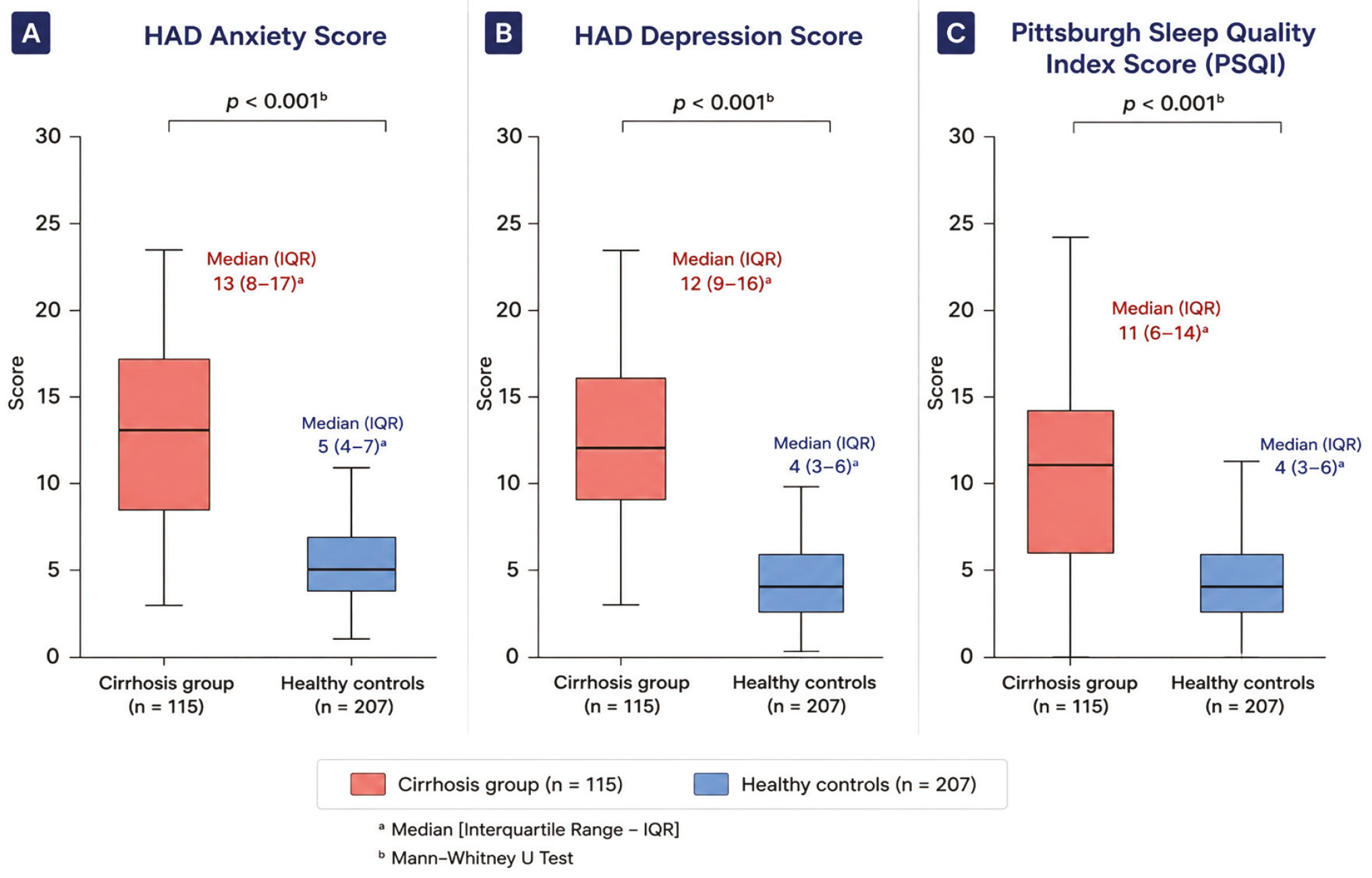
Comparison of HADS-Anxiety, HADS-Depression and Pittsburgh Sleep Quality Index (PSQI) scores between patients with cirrhosis and healthy controls. (A) HADS-Anxiety scores; (B) HADS-Depression scores; (C) PSQI scores. Data are presented as median IQR
HADS: Hospital Anxiety and Depression Scale; PSQI: Pittsburgh Sleep Quality Index; IQR: Interquartile range.
Table 3. Comparison of the cirrhotic patient group and the control group according to HADS-Anxiety, HADS-Depression and Pittsburgh Sleep Quality Index scores
Variable | Cirrhosis group (n=115) | Healthy controls (n=207) | pa |
|---|---|---|---|
HADS-Anxiety score | |||
No anxiety (n=187, 58.1%) | 19 (16.5%) | 168 (81.2%) | <0.001 |
Borderline anxiety (n=54, 16.8%) | 22 (19.1%) | 32 (15.4%) | |
Anxiety (n=81, 25.2%) | 74 (64.3%) | 7 (3.4%) | |
HADS-Depression score | |||
No depression (n=205, 63.7%) | 21 (18.3%) | 184 (88.9%) | <0.001 |
Borderline depression (n=37, 11.5%) | 18 (15.7%) | 19 (9.2%) | |
Depression (n=80, 24.8%) | 76 (66.0%) | 4 (1.9%) | |
Pittsburgh Sleep Quality Index | |||
Good sleep quality (n=125, 38.8%) | 17 (14.8%) | 108 (52.2%) | <0.001 |
Poor sleep quality (n=197, 61.2%) | 98 (85.2%) | 99 (47.8%) | |
pa: Chi-square test, HADS: Hospital Anxiety and Depression Scale
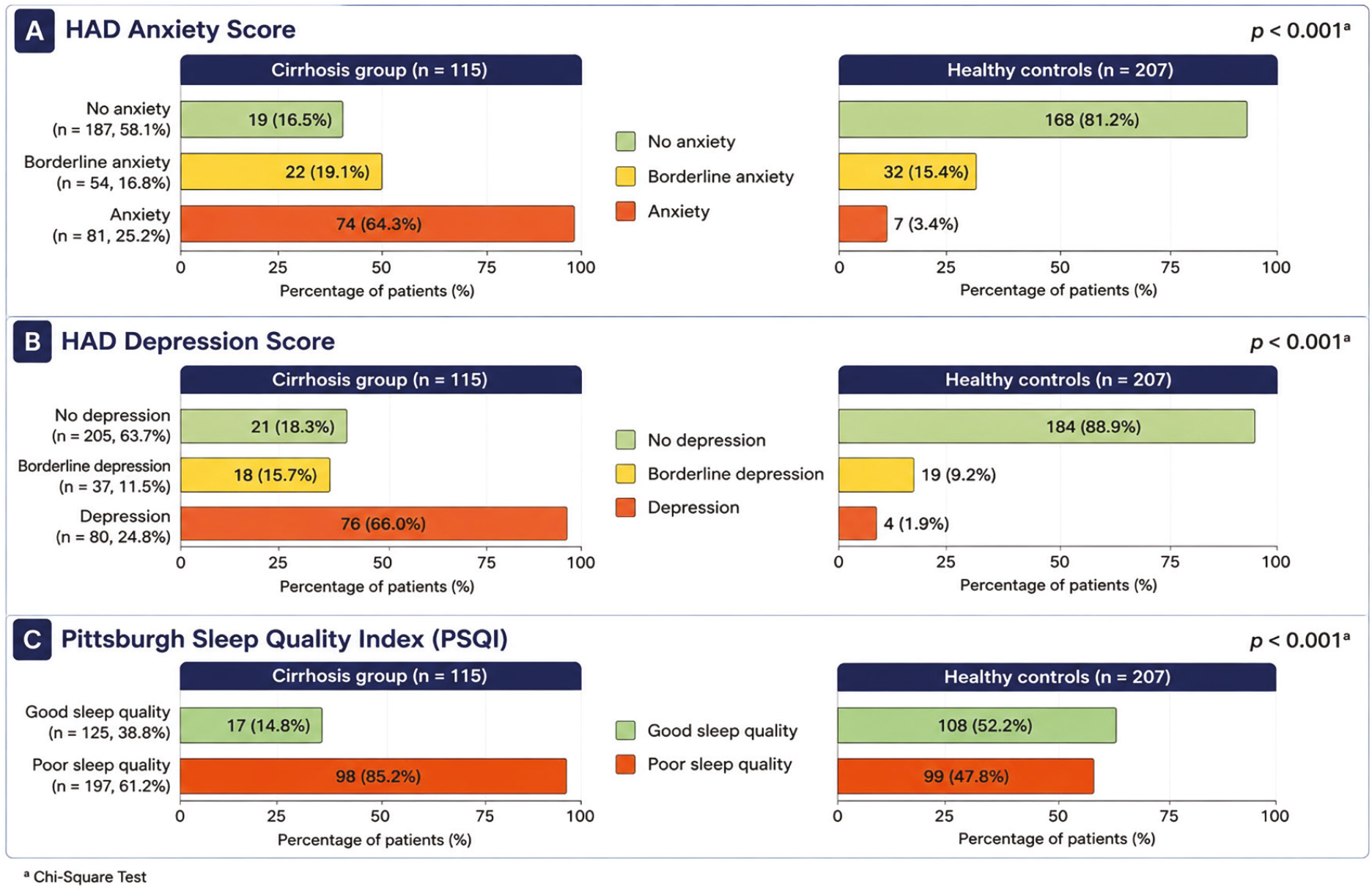
Distribution of anxiety, depression and sleep quality categories in patients with cirrhosis and healthy controls. (A) Anxiety categories according to HADS-Anxiety scores (no anxiety, borderline anxiety, and anxiety); (B) depression categories according to HADS-Depression scores (no depression, borderline depression, and depression); (C) sleep quality categories according to Pittsburgh Sleep Quality Index (PSQI) scores (good and poor sleep quality). Bars represent the number and percentage of participants in each category. Between-group comparisons were performed using the chi-square test (p<0.001 for all comparisons)
Significant positive correlations were observed between HADS-Anxiety scores and MELD-Na scores, as well as between HADS-Depression and PSQI scores and both disease severity indices (MELD-Na and Child-Pugh scores). However, no statistically significant correlation was detected between HADS-Anxiety and Child-Pugh scores (r=0.183, p=0.056; ). No significant differences were found in HADS or PSQI scores between compensated and decompensated cirrhosis; however, MELD-Na and Child-Pugh scores were higher in decompensated patients (p=0.021 and p=0.001, ). Correlation analyses further demonstrated significant associations between psychological assessment scores and selected laboratory parameters, including INR, bilirubin, albumin, sodium, and CRP levels ().
Table 4. Relationship between HADS-Anxiety score, HADS-Depression score, Pittsburgh Sleep Quality Index score and MELD-Na and Child-Pugh score in cirrhosis patient group
| Cirrhosis patients | |
|---|---|---|
Rho pa | ||
HADS-Anxiety, HADS-Depression | 0.754 | 0.001 |
HADS-anxiety, Pittsburgh Sleep Quality Index | 0.405 | 0.001 |
HADS-anxiety, MELD-Na score | 0.275 | 0.004 |
HADS-anxiety, Child-Pugh score | 0.183 | 0.056 |
HADS-Depression, Pittsburgh Sleep Quality Index | 0.553 | 0.001 |
HADS-Depression, MELD-Na score | 0.359 | 0.001 |
HADS-Depression, Child-Pugh score | 0.289 | 0.002 |
Pittsburgh Sleep Quality Index-MELD-Na score | 0.285 | 0.002 |
Pittsburgh Sleep Quality Index-Child-Pugh score | 0.262 | 0.005 |
rho: Correlation coefficient, a: Spearman Correlation test, HADS: Hospital Anxiety and Depression Scale, MELD-Na: Model for End-Stage Liver Disease-Sodium
Table 5. Comparison of HADS-Anxiety, HADS-Depression, Pittsburgh Sleep Quality Index, MELD-Na and Child scores between decompensated and compensated cirrhotic patient groups
| Patients with decompensated cirrhosis (n=88) | Patients with compensated cirrhosis (n=27) | p |
|---|---|---|---|
HADS-Anxiety | 12.90±5.72a | 12.70±5.30a | 0.953b |
HADS-Depression | 12.29±5.21a | 12.09±5.16a | 0.968b |
Pittsburgh Sleep Quality Index | 10.36±4.70a | 9.17±4.11a | 0.335b |
MELD-Na score | 12.49±6.23a | 10.08±6.20a | 0.021b |
Child score | 7.21±1.74a | 5.71±1.40a | 0.001b |
a: Mean ± standard deviation, b: Mann-Whitney U test, HADS: Hospital Anxiety and Depression Scale, MELD-Na: Model for End-Stage Liver Disease-Sodium
Table 6. Relationship between HADS-Anxiety, HADS-Depression and PSQI scores and biochemical and hematological parameters in patients with cirrhosis
HADS-Anxiety score | Pittsburgh Sleep Quality Index | HADS-Depression score | ||||
|---|---|---|---|---|---|---|
r | pa | r | pa | r | pa | |
Urea | 0.054 | 0.576 | 0.093 | 0.334 | 0.061 | 0.525 |
Creatinine | -0.057 | 0.554 | 0.090 | 0.343 | 0.054 | 0.567 |
AST | 0.113 | 0.234 | 0.043 | 0.655 | 0.064 | 0.499 |
ALT | -0.044 | 0.645 | -0.113 | 0.234 | -0.087 | 0.359 |
Direct bilirubin | 0.136 | 0.158 | 0.141 | 0.138 | 0.204 | 0.030 |
Total bilirubin | 0.179 | 0.059 | 0.056 | 0.562 | 0.192 | 0.043 |
Albumin | -0.122 | 0.205 | -0.210 | 0.028 | -0.286 | 0.002 |
Sodium | -0.309 | 0.001 | -0.249 | 0.008 | -0.310 | 0.001 |
Potassium | -0.014 | 0.884 | -0.058 | 0.544 | -0.104 | 0.274 |
LDL-cholesterol | -0.104 | 0.372 | -0.244 | 0.033 | -0.222 | 0.052 |
HDL-cholesterol | 0.058 | 0.620 | -0.233 | 0.041 | -0.138 | 0.231 |
Total cholesterol | -0.072 | 0.530 | -0.326 | 0.003 | -0.251 | 0.025 |
Triglyceride | -0.007 | 0.950 | 0.015 | 0.898 | -0.053 | 0.639 |
Leukocyte | 0.222 | 0.019 | 0.064 | 0.500 | 0.155 | 0.101 |
Hemoglobin | -0.048 | 0.612 | -0.291 | 0.002 | -0.093 | 0.328 |
Platelet | 0.007 | 0.946 | -0.108 | 0.254 | -0.048 | 0.616 |
Vitamin B12 | 0.097 | 0.393 | 0.115 | 0.308 | 0.002 | 0.985 |
INR | 0.203 | 0.036 | 0.286 | 0.003 | 0.253 | 0.008 |
CRP | 0.123 | 0.195 | 0.222 | 0.018 | 0.198 | 0.035 |
CRP/ALB ratio | 0.139 | 0.293 | 0.323 | 0.012 | 0.358 | 0.005 |
r: Correlation Coefficient, a: Spearman Correlation test, HADS: Hospital Anxiety and Depression Scale, PSQI: Pittsburgh Sleep Quality Index, AST: Aspartate aminotransferase, ALT: Alanine aminotransferase, LDL: Low-density lipoprotein, HDL: High-density lipoprotein, INR: International normalized ratio, CRP: C-reactive protein, ALB: Albumin
Discussion
This study demonstrated that patients with liver cirrhosis had significantly higher levels of anxiety and depression and poorer sleep quality than healthy controls. Our findings further showed that the associations between psychological symptoms and disease severity varied according to the assessment tool and severity index. While HADS-Anxiety scores were significantly correlated with MELD-Na scores, no statistically significant correlation was found with Child-Pugh scores. In contrast, HADS-Depression and PSQI scores were significantly correlated with both MELD-Na and Child-Pugh scores, highlighting the potential clinical importance of psychological assessment in the management of liver cirrhosis.
The high prevalence of anxiety and depression observed in our cohort suggests that psychological distress is a major yet frequently underrecognized component of liver cirrhosis. Our findings are consistent with the recent systematic review and meta-analysis by Abureesh et al. (), which confirmed that anxiety and depression are highly prevalent among patients with liver cirrhosis. Unlike earlier studies that primarily evaluated depression or sleep disturbances separately, our study simultaneously assessed anxiety, depression, and sleep quality, providing a more comprehensive evaluation of the psychological burden associated with liver cirrhosis.
The high prevalence of poor sleep quality in our cohort may be explained by several pathophysiological mechanisms associated with liver cirrhosis, including circadian rhythm disruption, altered melatonin metabolism, hepatic encephalopathy, and systemic inflammation (-). These mechanisms may also contribute to the close relationship between sleep disturbances and mood disorders observed in our study ().
Our findings further demonstrated that the associations between psychological symptoms and disease severity varied according to the assessment tool and severity index. Higher HADS-Anxiety scores were significantly correlated with higher MELD-Na scores, whereas no statistically significant correlation was observed with Child-Pugh scores. In contrast, higher HADS-Depression and PSQI scores were significantly correlated with both MELD-Na and Child-Pugh scores. These findings highlight the importance of routine psychological assessment and intervention in patients with liver cirrhosis. Similar associations have also been reported in previous studies (-). These findings are also consistent with recent evidence emphasizing the importance of recognizing and addressing psychological symptoms in patients with advanced liver disease ().
The main strength of our study is its comprehensive evaluation of anxiety, depression, and sleep quality across all etiologies of cirrhosis, along with their associations with MELD-Na and Child-Pugh classifications. To the best of our knowledge, this is the first study from Turkey to simultaneously evaluate anxiety, depression, sleep quality, and their associations with both MELD-Na and Child-Pugh scores in a single cohort of patients with liver cirrhosis.
Study Limitations
This study has several limitations, including its relatively small sample size, single-center design, and the lack of a detailed assessment of medication effects and psychosocial factors that may influence psychological symptoms and sleep quality. In addition, because the study was conducted at a tertiary referral center, the population may have included patients with more advanced or complex liver disease, potentially introducing referral bias and limiting the generalizability of our findings to the broader population with liver cirrhosis. Despite these limitations, our findings provide clinically relevant evidence regarding the psychological burden associated with liver cirrhosis and underscore the importance of routine psychological assessment in clinical practice.
Conclusion
Patients with liver cirrhosis exhibited significantly higher levels of anxiety and depression, as well as poorer sleep quality than healthy controls. These psychological symptoms were significantly associated with disease severity, as reflected by MELD-Na and Child-Pugh scores. Our findings support incorporating routine psychological assessment into the comprehensive evaluation of patients with liver cirrhosis, particularly those with more advanced disease. Early recognition of psychological symptoms may facilitate timely referral for appropriate mental health assessment and multidisciplinary care. Further multicenter prospective studies are warranted to confirm these findings.
Ethics
Ethics Committee Approval: Ethical approval for this study was obtained from the Clinical Research Ethics Committee of the University of Health Sciences Türkiye, Sancaktepe Sehit Prof. Dr. Ilhan Varank Training and Research Hospital (approval date: September 14, 2022; approval no: 114).
Informed Consent: This study was conducted in accordance with the principles of the Declaration of Helsinki. Written informed consent was obtained from all participants prior to inclusion in the study.
Footnotes
Authorship Contributions
Surgical and Medical Practices: Z.B.A., Concept: Z.B.A., Design: Z.B.A., A.T., M.C.S., Data Collection or Processing: M.Y., Analysis or Interpretation: A.T., S.B., Literature Search: Z.B.A., M.C.S., Writing: A.T., S.B.
Conflict of Interest
The authors declared that there were no conflicts of interest.
Financial Disclosure
The authors declared that this study received no financial support.
Declaration Regarding the Use of AI and AI-Assisted Technologies: Artificial intelligence-assisted tools were used for language editing, manuscript formatting, table preparation, and literature checking. All outputs were reviewed and verified by the authors. The authors take full responsibility for the content of the manuscript, the accuracy of the data, and the integrity of the work.
References
Peng JK, Hepgul N, Higginson IJ, Gao W. Symptom prevalence and quality of life of patients with end-stage liver disease: a systematic review and meta-analysis. Palliat Med. 2019;33:24-36.
Qin S, Cheng X, Zhang S, et al. Sleep patterns, genetic susceptibility, and risk of cirrhosis among individuals with non-alcoholic fatty liver disease. Hepatol Int. 2024;18:1158-67.
Dong S, Zhou S, Liu J, et al. Associations between sleep disorders and clinical outcomes of patients with primary biliary cholangitis. Adv Med Sci. 2024;69:385-90.
Zimbrean PC, Lok AS, Weinrieb RM, et al. Depression and anxiety management in cirrhosis. Hepatol Commun. 2025;9:e1234.
Zhao M, Yan Y, Wang X, Liu B, Luo X. Sleep disturbance in patients with cirrhosis and transjugular intrahepatic portosystemic shunt. BMC Gastroenterol. 2024;24:381.
Cooper KM, Colletta A, Osorio B, Herringshaw E, Talat A, Devuni D. History of depression is associated with higher prevalence of hepatic encephalopathy in patients with advanced liver disease. Am J Med. 2024;137:872-9.
Feng J, Wang Y, Li X, et al. Sleep disorders in patients with liver cirrhosis: mechanisms and clinical implications. J Clin Transl Hepatol. 2025;13:345-54.
Abureesh M, Alkhayyat M, Abualnadi I, et al. Epidemiology of depressive disorders in patients with liver cirrhosis: a population-based study in the United States. Prim Care Companion CNS Disord. 2022;24:20m02889.
Hernaez R, Kramer JR, Khan A, et al. Depression and anxiety are common among patients with cirrhosis. Clin Gastroenterol Hepatol. 2022;20:194-203.
Xiao G, Ye Q, Han T, Yan J, Sun L, Wang F. Study of the sleep quality and psychological state of patients with hepatitis B liver cirrhosis. Hepatol Res. 2018;48:275-82.
Hansen L, Patel K, Nguyen M, et al. Longitudinal changes in physical and psychological outcomes in cirrhosis. Clin Gastroenterol Hepatol. 2025;23:789-98.
Qiu S, Zhang H, Li Y, et al. Resilience and health-related quality of life in patients with cirrhosis. Sci Rep. 2026;16:12345.
Abureesh O, Al-Shraideh A, Sleiman J, et al. Global prevalence and predictors of depression and anxiety in patients with liver cirrhosis: a systematic review and meta-analysis. Front Epidemiol. 2026;6:1740227.
Bruyneel M, Sersté T. Sleep disturbances in patients with liver cirrhosis: prevalence, impact, and management challenges. Nat Sci Sleep. 2018;10:369-75.
Nardelli S, Pentassuglio I, Pasquale C, et al. Depression, anxiety and alexithymia symptoms are major determinants of health related quality of life (HRQoL) in cirrhotic patients. Metab Brain Dis. 2013;28:239-43.
Montagnese S, De Pittà C, De Rui M, et al. Sleep-wake abnormalities in patients with cirrhosis. Hepatology. 2014;59:705-12.
Zhao M, Yan Y, Wang X, et al. Sleep disturbance in patients with cirrhosis and transjugular intrahepatic portosystemic shunt. BMC Gastroenterol. 2024;24:38
Yao S, Peng B, Liu W, Yang J, Hui Y, Sun C. Skeletal muscle abnormalities negatively linked to sleep disturbances in patients with liver cirrhosis: a cross-sectional study. Eur J Med Res. 2025;30:917.
Zhang T, Liu H, Li L, Wang Y, Chen Y. Anxiety, depression, and sleep disorders in patients with hepatitis B-related cirrhosis: a cross-sectional study. Medicine(Baltimore). 2017;96:e7967.
Jeong SW, Jang JY, Kim YJ, et al. Clinical significance of depression and anxiety in patients with liver cirrhosis. Clinical and Molecular Hepatology. 2019;25:406-15.
Li M, Yu B, Yang H, He H, Gao R. Comparative efficacy of non-pharmacological interventions on anxiety, depression, sleep disorder, and quality of life in patients with liver transplantation: a systematic review and network meta-analysis. J Clin Nurs. 2025;34:1993-2010.