
Abstract
Aim: The extant literature contains conflicting findings with regard to the safety of Sodium-glucose cotransporter-2 inhibitors (SGLT-2 inhibitors) in patients with diabetic foot ulcers (DFUs). The present study aims to evaluate the association between the use of SGLT-2 inhibitors and wound healing outcomes and the risk of amputation in patients diagnosed with type 2 diabetes mellitus (DM) and Wagner stage 1-2 DFU.
Methods: This prospective observational study was conducted between March 1, 2023, and August 31, 2024. The study population comprised 208 patients with type 2 DM and Wagner stage 1-2 DFU, all of whom completed six months of follow-up. Patients were grouped according to treatment: metformin plus insulin (n=102) or metformin plus insulin and an SGLT-2 inhibitor (n=106). Clinical, biochemical, wound-healing, and amputation outcomes were compared between groups. Subgroup analyses were performed for users of dapagliflozin and empagliflozin. Associations of SGLT-2 inhibitor use with wound healing and amputation were assessed using ordinal and binary logistic regression, respectively, with multivariable adjustment for relevant baseline differences.
Results: No statistically significant differences in wound healing and amputation rates were observed between patients with and without SGLT-2 inhibitor use. In the SGLT-2 inhibitor group, levels of serum albumin were elevated, whereas urinary albumin excretion was reduced (p=0.002 and p<0.001, respectively). No significant differences were observed between patients treated with dapagliflozin and empagliflozin in terms of wound healing or amputation.
Conclusion: No clear association has been observed between the use of SGLT-2 inhibitors and impaired wound healing or amputation in patients with DFUs. Further studies with larger sample sizes are needed to clarify these findings.
Keywords: Diabetes mellitus, type 2, foot ulcer, sodium-glucose transporter 2 inhibitors, wound healing
Introduction
Diabetes mellitus (DM) is a metabolic disorder characterized by hyperglycemia and multisystemic effects; the most common subtype is type 2 DM. DM has been shown to be associated with a wide range of macrovascular and microvascular complications (). Diabetic foot ulcers (DFUs) represent a prevalent and grave complication associated with type 2 DM. As demonstrated in the extant literature, there is a strong correlation between DFUs and an elevated risk of infection, lower limb amputation, and death (,). The primary objective in the management of DM and its complications must be to select medications that exhibit a minimal side effect profile and are efficacious in addressing the pathophysiology underlying the condition. Sodium-glucose cotransporter-2 inhibitors (SGLT-2 inhibitors) constitute a class of oral antidiabetic agents recommended for suitable patients because of their beneficial cardiovascular, renal, and metabolic effects (). However, concerns have been raised regarding a potential increased risk of lower-extremity amputation, particularly following the CANVAS program, which reported a higher amputation rate with canagliflozin (). In contrast, subsequent studies with dapagliflozin and empagliflozin have not consistently demonstrated a similar risk, leading to ongoing debate in the literature. In addition, the potential effects of SGLT-2 inhibitors on wound healing remain unclear (). The present study examined the impact of the use of SGLT-2 inhibitors (i.e., empagliflozin and dapagliflozin) on wound healing and amputation in patients with type 2 DM and Wagner stage 1-2 DFUs. We hypothesized that wound-healing and amputation outcomes would differ based on SGLT-2 inhibitor use among patients with Wagner grade 1-2 DFUs. This study aims to contribute to the existing literature by comparing SGLT-2 inhibitor use among patients with DFUs.
Materials and Methods
Compliance with Ethical Standards
The study was approved by the Clinical Research Ethics Committee of University of Health Sciences Türkiye, Adana City Training and Research Hospital (decision no: 2372, date: 12.01.2023). The study was conducted in accordance with the ethical principles outlined in the Declaration of Helsinki, and written informed consent was obtained from all participants.
Study Design
This was a prospective observational study conducted at the Clinic of Internal Medicine Adana City Training and Research Hospital between March 1, 2023, and August 31, 2024, with a 6-month follow-up period. The initial phase of the study involved 222 patients. During follow-up, five patients died and nine were lost to follow-up. Therefore, the final analysis included 208 patients (). The study consisted of 102 patients receiving metformin plus insulin therapy and 106 patients treated with metformin, insulin, and an SGLT-2 inhibitor.
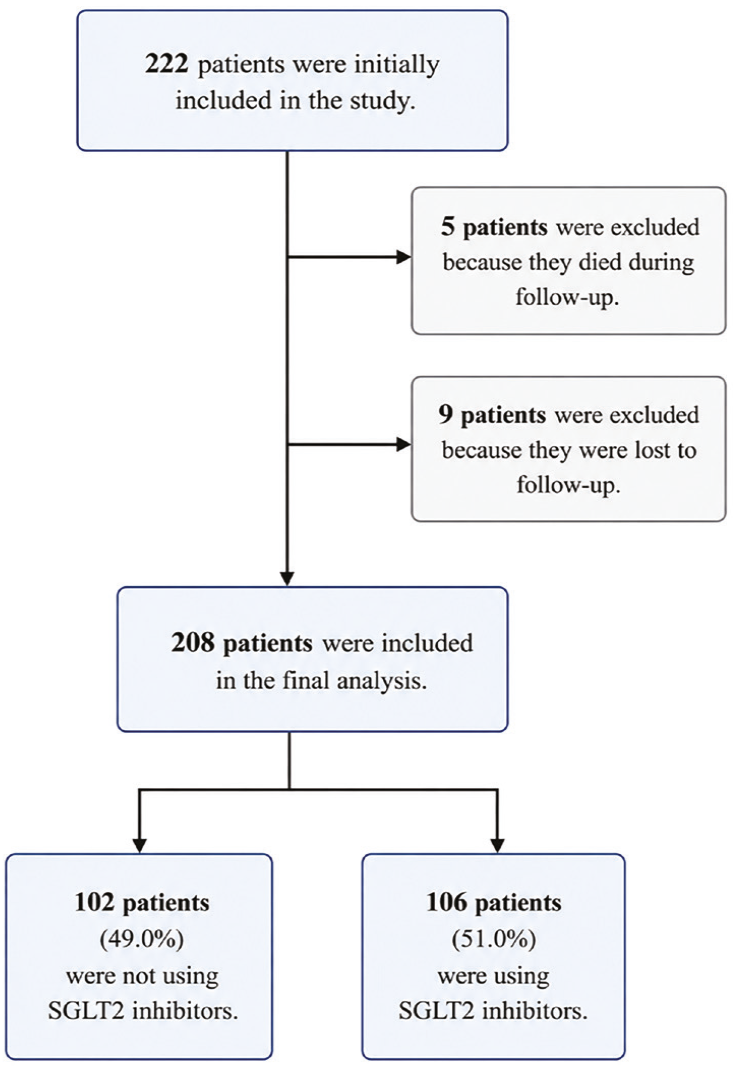
Flowchart of patient selection
SGLT-2 inhibitors: Sodium-glucose cotransporter-2 inhibitors
Data Collection and Clinical Assessment
Baseline demographic characteristics, duration of diabetes, body mass index, glycated hemoglobin (HbA1c) levels, complete blood count, and biochemical parameters were recorded. Hyperbaric oxygen therapy status was also documented.
The primary outcome of the study was wound healing, which was evaluated based on changes in Wagner stage and classified into three categories: regression (A) (improvement to a lower stage), no change (remaining the same stage) (B), and progression (C) (advancement to a higher stage). The secondary outcome variable was defined as the occurrence of lower-extremity amputation during the follow-up period. All patients received education on wound care and nutrition in accordance with institutional protocols and were referred to relevant physicians for antibiotic therapy.
Study Groups
The division of patients into two groups was based on treatment regimen:
(1) Metformin plus insulin, and
(2) Metformin plus insulin plus an SGLT-2 inhibitor (dapagliflozin or empagliflozin).
Inclusion and Exclusion Criteria
Inclusion criteria were as follows: age ≥18 years, diagnosis of type 2 DM, presence of Wagner stage 1-2 DFUs, treatment with metformin plus insulin with or without an SGLT-2 inhibitor, and absence of significant arterial or venous stenosis (<50%). Patients who tolerated the treatment and had not discontinued it due to other adverse effects were included in the study; therefore, patients in the SGLT-2 inhibitor group were required to have received this treatment for at least six months prior to study inclusion.
Exclusion criteria included age <18 years, pregnancy, malignancy, rheumatologic disease, end-stage renal disease, prior amputation, and psychiatric disorders impairing self-care. In addition, patients with advanced DFUs (Wagner ≥3), severe arterial or venous stenosis (≥50%), or conditions such as elephantiasis were excluded. Arterial and venous stenoses were assessed using color Doppler ultrasonography.
Statistical Analysis
Statistical analyses were conducted using IBM SPSS Statistics for Windows, version 20.0 (IBM Corp., Armonk, NY, USA). Descriptive data were summarized as frequency and percentage for categorical variables and as mean ± standard deviation or median (minimum-maximum) for continuous variables, depending on data distribution. Patients were compared by SGLT-2 inhibitor use (yes/no) and subtype (dapagliflozin vs. empagliflozin). Associations between categorical variables were evaluated using the chi-square test. For wound healing, assessed as an ordinal outcome (improvement, no change, and progression), a common odds ratio (OR) and its 95% confidence interval (CI) were estimated using ordinal logistic regression. For amputation, an OR with a 95% CI was calculated using binary logistic regression. Additionally, multivariable-adjusted analyses were performed for both outcomes to account for significant baseline differences in serum albumin, sodium, and the spot urine albumin-to-creatinine ratio. ORs with 95% CIs were reported. Normality of continuous variables was assessed with the Kolmogorov-Smirnov test. Continuous variables with a normal distribution were analyzed using the independent-samples t-test, whereas non-normally distributed variables were compared using the Mann-Whitney U test. Patients who discontinued SGLT-2 inhibitor treatment during follow-up remained in the analysis according to their treatment group at study entry. A two-sided p-value <0.05 was considered statistically significant.
Results
The initial phase of the study involved 222 patients. During follow-up, five patients died and nine were lost to follow-up. Therefore, the final analysis was performed on 208 patients. The study consisted of 102 patients receiving metformin plus insulin therapy and 106 patients treated with metformin, insulin, and an SGLT-2 inhibitor (). presents the baseline demographic, clinical, and laboratory characteristics of the study population in accordance with treatment groups. Significant differences were observed in spot urine albumin-to-creatinine ratio, serum albumin, and sodium levels (p=0.002, p=0.001, and p=0.017, respectively). Patients receiving SGLT-2 inhibitors had significantly lower spot albuminuria and higher serum albumin levels.
Table 1. Demographic, clinical, and laboratory characteristics across SGLT-2 inhibitor groups
SGLT-2 inhibitors | p | ||
|---|---|---|---|
No (n=102) | Yes (n=106) | ||
Age, years | 61.5 (39.0-82.0) | 61.0 (36.0-76.0) | 0.384 |
Sex, n (%) | 0.220 | ||
Male Female | 64 (62.7) 38 (37.3) | 75 (70.8) 31 (29.2) | |
Wagner grade, n (%) | 0.299 | ||
Grade 1 Grade 2 | 38 (37.3) 64 (62.7) | 47 (44.3) 59 (55.7) | |
BMI (kg/m2) | 28.9 (22.6-40.3) | 27.1 (22.7-37.8) | 0.314 |
ALT (U/L) | 14.0 (3.0-64.0) | 16.0 (4.0-61.0) | 0.129 |
AST (U/L) | 16.0 (8.0-68.0) | 16.0 (8.0-57.0) | 0.732 |
Hemoglobin (g/dL) | 11.9±1.8 | 12.0±1.9 | 0.597 |
WBC (×103/µL) | 9.6 (3.6-28.9) | 9.0 (3.9-33.0) | 0.086 |
Neutrophil count (×103/µL) | 6.6 (2.0-25.8) | 6.1 (2.2-30.0) | 0.098 |
Lymphocyte count (×103/µL) | 1.9 (0.5-6.0) | 1.9 (0.4-4.4) | 0.658 |
Monocyte count (×103/µL) | 0.65 (0.1-2.2) | 0.65 (0.1-1.8) | 0.827 |
Platelet count (×103/µL) | 308.0 (145.0-663.0) | 291.0 (140.0-690.0) | 0.523 |
Serum albumin (g/dL) | 3.7 (1.9-4.6) | 4.0 (1.6-4.7) | 0.001 |
eGFR (mL/min/1.73 m2) | 90.0 (40.0-128.0) | 90.0 (38.0-132.0) | 0.514 |
eGFR | 0.777 | ||
≥90 mL/min/1.73 m2 <90 mL/min/1.73 m2 | 53 (52.0) 49 (48.0) | 53 (50.0) 53 (50.0) | |
Urea (mg/dL) | 37.0 (13.0-94.0) | 38.0 (16.0-138.0) | 0.575 |
Creatinine (mg/dL) | 0.9 (0.4-1.7) | 0.9 (0.4-2.2) | 0.999 |
C-reactive protein (mg/L) | 27.5 (3.0-327.0) | 30.0 (1.0-270.0) | 0.893 |
Sodium (mmol/L) | 137.5 (124.0-147.0) | 139.0 (127.0-141.0) | 0.017 |
Potassium (mmol/L) | 4.5±0.4 | 4.5±0.5 | 0.797 |
HbA1c-baseline | 9.6 (5.1-16.4) | 9.6 (6.3-18.2) | 0.637 |
HbA1c-6th month | 9.0 (5.2-15.9) | 8.9 (5.8-17.0) | 0.712 |
Duration of diabetes, years | 9.5 (2.0-28.0) | 8.0 (1.0-20.0) | 0.142 |
Spot urine albumin-to-creatinine ratio (mg/g) | 150.0 (0.0-5579.0) | 75.0 (2.0-4239.0) | 0.002 |
Hyperbaric oxygen therapy, n (%) | 0.746 | ||
No Yes | 91 (89.2) 11 (10.8) | 92 (86.8) 14 (13.2) | |
Unless otherwise indicated, variables are expressed as mean ± standard deviation or median (minimum-maximum). Categorical variables were compared according to SGLT-2 inhibitor use using the chi-square test. Continuous variables are presented as mean ± standard deviation and were compared using the independent-samples t-test, or as median (min-max) and were compared using the Mann-Whitney U test, as appropriate BMI: Body mass index, ALT: Alanine aminotransferase, AST: Aspartate aminotransferase, WBC: White blood cell count, eGFR: Estimated glomerular filtration rate, HbA1c: Glycated hemoglobin, SGLT-2 inhibitors: Sodium-glucose cotransporter-2 inhibitors
At the 6-month follow-up, no statistically significant between-group differences were observed for wound healing (common OR=0.64, 95% CI: 0.39-1.07, p=0.090) for lower-extremity amputation (OR=0.67, 95% CI: 0.35-1.25, p=0.264) (, ). After adjustment for serum albumin, sodium, and spot urine albumin-to-creatinine ratio, SGLT-2 inhibitor use remained not significantly associated with wound healing (aOR=0.77, 95% CI: 0.45-1.30, p=0.324) or with amputation (aOR=0.81, 95% CI: 0.42-1.55, p=0.522).
Table 2. Wound healing and amputation outcomes at 6 months according to SGLT-2 inhibitor use
SGLT-2 inhibitors | Adjusted p | |||||
|---|---|---|---|---|---|---|
No (n=102) | Yes (n=106) | Crude effect size (95% CI) | Crude p | Adjusted effect size (95% CI) | ||
Wound healing, n (%) | ||||||
A B C | 37 (36.3%) 21 (20.6) 44 (43.1) | 50 (47.2) 21 (19.8) 35 (33.0) | Common OR 0.64 (0.39-1.07) | 0.090 | aOR 0.77 (0.45-1.30) | 0.324 |
Amputation, n (%) | ||||||
No Yes | 72 (70.6) 30 (29.4) | 83 (78.3) 23 (21.7) | OR 0.67 (0.35-1.25) | 0.264 | aOR 0.81 (0.42-1.55) | 0.522 |
A: Improvement in Wagner grade, B: No change in Wagner grade, C: Progression in Wagner grade. Categorical variables were compared according to SGLT-2 inhibitor use using the chi-square test. For wound healing, the common odds ratio was estimated using ordinal logistic regression, with categories ordered as improvement, no change, and progression. Adjusted analyses included serum albumin, sodium, and spot urine albumin-to-creatinine ratio as covariates OR: Odds ratio, aOR: Adjusted odds ratio, Cl: Confidence interval, SGLT-2 inhibitors: Sodium-glucose cotransporter-2 inhibitors
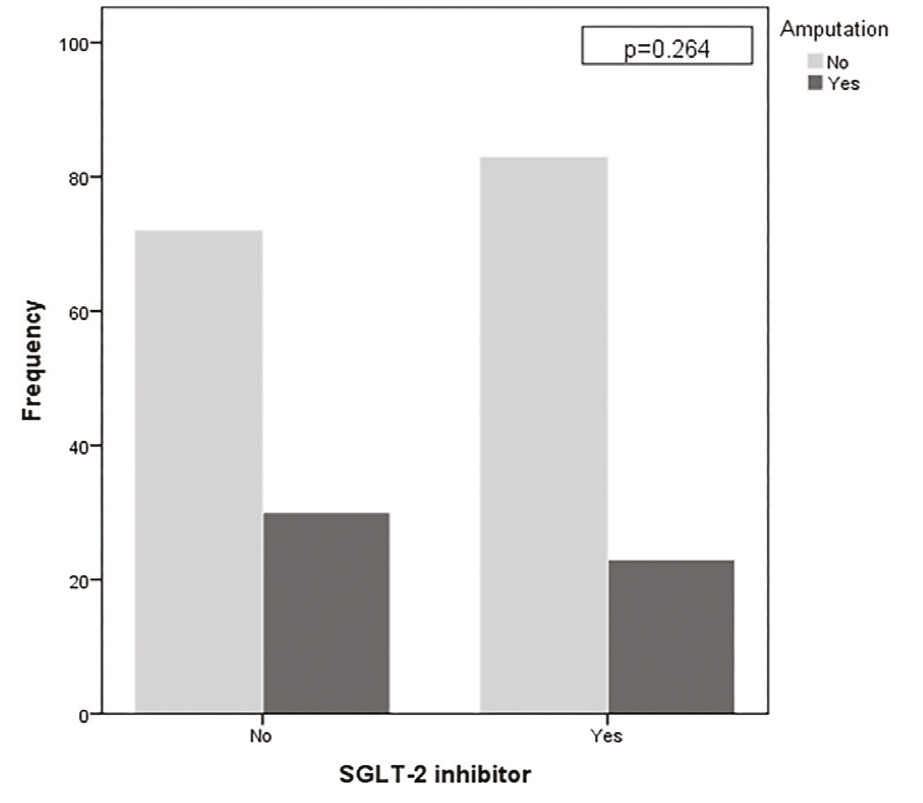
Amputation rates according to SGLT-2 inhibitor use
SGLT-2 inhibitors: Sodium-glucose cotransporter-2 inhibitors
presents a comparison of baseline demographic, clinical, and laboratory characteristics among patients receiving SGLT-2 inhibitors, stratified by inhibitor type [dapagliflozin (n=61) vs. empagliflozin (n=45)].
Table 3. Demographic, clinical, and laboratory characteristics of patients receiving SGLT-2 inhibitors according to treatment type
SGLT-2 inhibitor type | p | ||
|---|---|---|---|
Dapagliflozin (n=61) | Empagliflozin (n=45) | ||
Age, years | 62.0 (36.0-76.0) | 59.0 (38.0-71.0) | 0.060 |
Sex, n (%) | |||
Male Female | 43 (70.5) 18 (29.5) | 32 (71.1) 13 (28.9) | 0.945 |
Wagner grade, n (%) | |||
Grade 1 Grade 2 | 24 (39.3) 37 (60.7) | 23 (51.1) 22 (48.9) | 0.314 |
BMI (kg/m2) | 27.1 (22.7-37.8) | 27.0 (23.6-35.2) | 0.638 |
ALT (U/L) | 14.0 (4.0-57.0) | 16.0 (6.0-61.0) | 0.067 |
AST (U/L) | 16.0 (8.0-52.0) | 17.0 (10.0-57.0) | 0.107 |
Hemoglobin (g/dL) | 11.8±1.8 | 12.4±1.9 | 0.118 |
WBC (×103/µL) | 9.1 (3.9-20.9) | 8.6 (4.8-33.0) | 0.964 |
Neutrophil count (×103/µL) | 6.2 (2.2-19.9) | 5.7 (2.3-30.0) | 0.906 |
Lymphocyte count (×103/µL) | 1.8±0.8 | 2.1±0.7 | 0.057 |
Monocyte count (×103/µL) | 0.6 (0.3-1.3) | 0.7 (0.1-1.8) | 0.524 |
Platelet count (×103/µL) | 279.0 (144.0-690.0) | 298.0 (140.0-525.0) | 0.742 |
Serum albumin (g/dL) | 4.0 (1.6-4.7) | 3.9 (2.5-4.4) | 0.529 |
eGFR (mL/min/1.73 m2) | 91.0 (38.0-132.0) | 88.0 (41.0-120.0) | 0.992 |
eGFR | |||
≥90 mL/min/1.73 m2 <90 mL/min/1.73 m2 | 31 (50.8) 30 (49.2) | 22 (48.9) 23 (51.1) | 0.844 |
Urea (mg/dL) | 41.9±18.4 | 42.6±18.1 | 0.853 |
Creatinine (mg/dL) | 0.9 (0.4-2.2) | 0.9 (0.4-1.6) | 0.974 |
C-reactive protein (mg/L) | 40.0 (4.0-270.0) | 23.0 (1.0-234.0) | 0.130 |
Sodium (mmol/L) | 138.0 (127.0-145.0) | 139.0 (130.0-141.0) | 0.775 |
Potassium (mmol/L) | 4.5±0.5 | 4.5±0.5 | 0.741 |
HbA1c-baseline | 9.4 (6.3-14.7) | 9.6 (6.8-18.2) | 0.383 |
HbA1c-6th month | 9.0 (5.8-14.2) | 8.9 (6.0-17.0) | 0.913 |
Duration of diabetes, years | 8.0 (2.0-20.0) | 8.0 (1.0-16.0) | 0.430 |
Spot urine albumin-to-creatinine ratio (mg/g) | 84.0 (5.0-4239.0) | 36.0 (2.0-3510.0) | 0.106 |
Hyperbaric oxygen therapy, n (%) | |||
No Yes | 55 (90.2) 6 (9.8) | 37 (82.2) 8 (17.8) | 0.366 |
Unless otherwise indicated, variables are expressed as mean ± standard deviation or median (minimum-maximum). Categorical variables were compared according to SGLT-2 inhibitor use using the chi-square test. Continuous variables are presented as mean ± standard deviation and were compared using the independent-samples t-test, or as median (min-max) and were compared using the Mann-Whitney U test, as appropriate BMI: Body mass index, ALT: Alanine aminotransferase, AST: Aspartate aminotransferase, WBC: White blood cell count, eGFR: Estimated glomerular filtration rate, HbA1c: Glycated hemoglobin, SGLT-2 inhibitors: Sodium-glucose cotransporter-2 inhibitors
shows that there were no major differences in wound healing or in the number of amputations among patients taking either dapagliflozin or empagliflozin, both SGLT-2 inhibitors ().
Table 4. Wound healing and amputation outcomes at 6 months according to SGLT-2 inhibitor type
| SGLT-2 inhibitor type | p | |
|---|---|---|---|
Dapagliflozin (n=61) | Empagliflozin (n=45) | ||
Wound healing, n (%) | |||
A B C | 27 (44.2) 10 (16.4) 24 (39.3) | 23 (51.1) 11 (24.4) 11 (24.4) | 0.241 |
Amputation, n (%) | |||
No Yes | 44 (72.1) 17 (27.9) | 39 (86.7) 6 (13.3) | 0.120 |
A: Improvement in Wagner grade, B: No change in Wagner grade, C: Progression in Wagner grade. Categorical variables were compared according to SGLT-2 inhibitor type using the chi-square test
SGLT-2 inhibitors: Sodium-glucose cotransporter-2 inhibitors
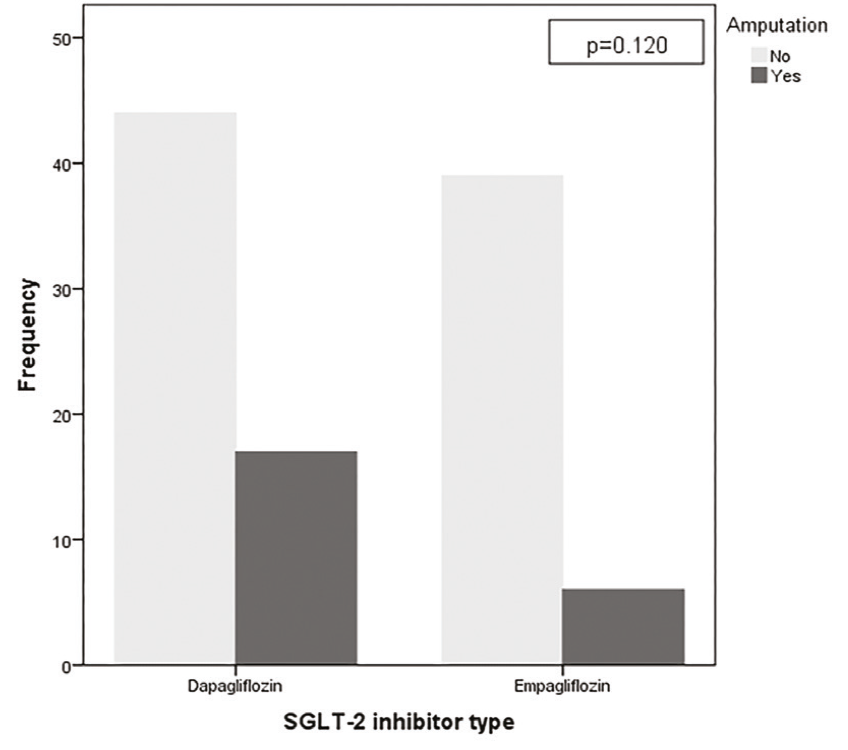
Amputation rates according to SGLT-2 inhibitor type
SGLT-2 inhibitors: Sodium-glucose cotransporter-2 inhibitors
Discussion
According to the study, neither empagliflozin nor dapagliflozin was clearly associated with impaired wound healing or increased amputation rates in patients with Wagner stage 1-2 ulcers. A similar result was obtained in a single-center retrospective study by Dumortier et al. (). In Dumortier et al.’s () study, patients with DFUs receiving SGLT-2 inhibitors were compared with patients not receiving SGLT-2 inhibitors. Over a six-month period, there was no clear association between wound healing rates in groups receiving SGLT-2 inhibitors and those not receiving SGLT-2 inhibitors. Furthermore, during the one-year follow-up period, the use of SGLT-2 inhibitors was not clearly associated with an increased risk of amputation. Similar to our study, this study included patients who received empagliflozin or dapagliflozin, but not canagliflozin. Furthermore, the follow-up time for wound healing was similar. This may have contributed to the consistency of the findings between the two studies. In that study, wound care and antibiotic treatment were standardized for the patients (). However, no such standardization was applied in our study.
As shown in the studies by Chen et al. () and Pavithra and Kaliyaperumal (), the healing process of DFUs is influenced by numerous factors, including debridement, wound care, and antibiotic treatment. In the present study, the lack of standardization in antibiotic treatment and wound care may have had a significant impact on the results.
A study by Sung et al. () did not observe a clear association between the use of SGLT-2 inhibitors and an increased risk of amputation. This study, similar to our own, examined patients with active diabetic ulcers. The duration of DM and the HbA1c levels were comparable between the groups. Of the 27 patients using SGLT-2 inhibitors, only one used canagliflozin, while the others used empagliflozin or dapagliflozin. The similarity between the findings of the two studies may be explained by these factors. However, unlike our study, that study did not examine the wound healing process and the wound stages of the patients were not clearly determined.
Jiang et al. () associated peripheral artery disease and advanced Wagner’s stage ulcers with increased amputation rates in patients with DFUs. The present study did not include patients with advanced peripheral artery disease or advanced Wagner’s stage ulcers. Therefore, the findings of this study do not permit definitive conclusions regarding the overall safety of SGLT-2 inhibitor use in patients with DFUs.
Heyward et al. () reported no clear association between SGLT-2 inhibitor use and the overall risk of amputation. However, the amputation signal observed with canagliflozin requires further investigation. The CANVAS program (Canagliflozin Cardiovascular Assessment Study) revealed that patients treated with canagliflozin had approximately twice the risk of amputation (). However, large randomized controlled trials, such as the EMPA-REG OUTCOME (Empagliflozin Cardiovascular Outcome Event Trial) and DECLARE-TIMI 58 (Dapagliflozin Effect on Cardiovascular Events) trials, did not find a similar increase in amputation risk for empagliflozin and dapagliflozin (,). Even in larger studies, the available evidence remains insufficient to draw definitive conclusions regarding the effect of SGLT-2 inhibitors on DFU healing or amputation risk.
Study Limitations
The interpretation of the findings of the present study should be considered in light of several limitations. First, the study was a single-center study with a relatively small sample size, which may limit the generalizability of our findings to other patient populations and clinical settings. Second, only patients with Wagner stage 1-2 ulcers were included; therefore, the findings cannot be generalized to patients with advanced ulcers or severe peripheral arterial disease. Third, wound care practices and antibiotic regimens were not completely standardized and may have affected wound healing outcomes, representing a potential source of confounding. Fourth, primary care doctors stopped SGLT-2 inhibitor treatment for some patients whose wound stage worsened during follow-up, but these patients were still observed and included in the analysis. In addition, no a priori sample size calculation was performed, as all eligible patients presenting during the predefined study period were consecutively included. Therefore, the study may have had limited statistical power to detect clinically meaningful between-group differences, and the possibility of a type II error cannot be excluded. Finally, insulin regimens and antidiabetic drug doses were not analyzed in detail. Despite these limitations, the prospective observational design, the inclusion of a well-defined population with Wagner stage 1-2 DFUs, and the evaluation of both wound-healing and amputation outcomes during a 6-month follow-up represent strengths of the present study. In addition, multivariable-adjusted analyses accounted for potential baseline confounders.
Conclusion
This study did not find a clear association between use of dapagliflozin or empagliflozin and impaired wound healing or increased amputation rates in patients with Wagner stage 1-2 DFUs. However, the findings should be interpreted with caution, given the observational design and the limited statistical power of the study. Larger-scale prospective studies with sufficient statistical power are required to establish a clearer association in this regard.
Ethics
Ethics Committee Approval: The study was approved by the Clinical Research Ethics Committee of University of Health Sciences Türkiye, Adana City Training and Research Hospital (decision no: 2372, date: 12.01.2023).
Informed Consent: Written informed consent was obtained from all participants.
Footnotes
Authorship Contributions
Surgical and Medical Practices: Z.G.T., T.S., Concept: Z.G.T., T.S., Design: Z.G.T., S.P.Y.K., T.S., Data Collection or Processing: Z.G.T., S.P.Y.K., T.S., Analysis or Interpretation: Z.G.T., S.P.Y.K., T.S., Literature Search: Z.G.T., T.S., Writing: Z.G.T., S.P.Y.K., T.S.
Conflict of Interest
The authors declared that there were no conflicts of interest.
Financial Disclosure
The authors declared that this study received no financial support.
References
Harreiter J, Roden M. Diabetes mellitus—Definition, klassifikation, diagnose, screening und prävention (update 2026) [Diabetes mellitus-definition, classification, diagnosis, screening and prevention (update 2026)]. Wien Klin Wochenschr. 2026;138(Suppl 4):76-86. German.
Kim JM, Kang SM, Jung JH, et al. Comprehensive management of diabetic foot ulcers: current evidence and practice. J Diabetes. 2026;18:e70221.
American Diabetes Association Professional Practice Committee for Diabetes*. 12. Retinopathy, neuropathy, and foot care: standards of care in diabetes-2026. Diabetes Care. 2026;49:261-76.
American Diabetes Association Professional Practice Committee for Diabetes*. 9. Pharmacologic approaches to glycemic treatment: standards of care in diabetes-2026. Diabetes Care. 2026;49:183-215.
Perkovic V, de Zeeuw D, Mahaffey KW, et al. Canagliflozin and renal outcomes in type 2 diabetes: results from the CANVAS Program randomised clinical trials. Lancet Diabetes Endocrinol. 2018;6:691-704.
Lin C, Zhu X, Cai X, et al. SGLT2 inhibitors and lower limb complications: an updated meta-analysis. Cardiovasc Diabetol. 2021;20:91.
Dumortier C, Aho Glele S, Rouland A, et al. Effects of sodium-glucose cotransporter 2 inhibitor use on mortality, amputation, and healing in patients with diabetic foot ulcer. Diabetes Care. 2026;49:674-81.
Chen P, Ahluwalia R, Chuo CB, Johnson-Lynn SE. Management of the acute diabetic foot: an update. Bone Joint J. 2026;108-B:322-30.
Pavithra TR, Kaliyaperumal R. Epidemiology, pathophysiology, and management of diabetic foot: a comprehensive review. Foot (Edinb). 2026;66:102225.
Sung J, Padmanabhan S, Gurung S, et al. SGLT2 inhibitors and amputation risk: real-world data from a diabetes foot wound clinic. J Clin Transl Endocrinol. 2018;13:46-7.
Jiang Y, Ran X, Jia L, et al. Epidemiology of type 2 diabetic foot problems and predictive factors for amputation in China. Int J Low Extrem Wounds. 2015;14:19-27.
Heyward J, Mansour O, Olson L, Singh S, Alexander GC. Association between sodium-glucose cotransporter 2 (SGLT2) inhibitors and lower extremity amputation: a systematic review and meta-analysis. PLoS One. 2020;15:e0234065.
Zinman B, Wanner C, Lachin JM, et al. Empagliflozin, cardiovascular outcomes, and mortality in type 2 diabetes. N Engl J Med. 2015;373:2117-28.
Mosenzon O, Wiviott SD, Cahn A, et al. Effects of dapagliflozin on development and progression of kidney disease in patients with type 2 diabetes: an analysis from the DECLARE-TIMI 58 randomised trial. Lancet Diabetes Endocrinol. 2019;7:606-17.