
Abstract
A 64-year-old man presented with a 3-month history of postprandial abdominal pain and weight loss. Abdominal computed tomographic angiography (CTA) revealed a long-segment total occlusion of the superior mesenteric artery (SMA). Chest CTA incidentally detected a 3-cm left ventricular (LV) aneurysm. Coronary angiography demonstrated 80% stenosis of the left anterior descending (LAD) artery and a woven coronary artery anomaly involving the distal left circumflex artery. Following median sternotomy, the 6 × 3-cm LV aneurysm was resected, and the intraluminal thrombus was removed. Coronary artery bypass grafting to the LAD artery was then performed using the left internal mammary artery. Fourteen days later, a second operation was performed, during which a saphenous vein graft was used to create a retrograde bypass between the right common iliac artery and the SMA. This case highlights the importance of comprehensive cardiac evaluation in patients with chronic mesenteric ischemia and demonstrates that staged retrograde SMA bypass can be performed safely in selected patients.
Keywords: Mesenteric Ischemia, aneurysm, coronary vessel anomalies
Introduction
Mesenteric artery stenosis (MAS) results in inadequate blood flow to the gastrointestinal tract, leading to chronic mesenteric ischemia (CMI), which significantly impairs patients’ quality of life (). The rich and complex collateral system within the intestines protects against potential ischemia (). This is particularly important in patients with occlusion of more than one mesenteric artery. Chronic mesenteric ischemia may occur due to factors such as atrial fibrillation (AF), which can lead to mesenteric artery embolism; atherosclerosis, which can cause mesenteric artery thrombosis; and, rarely, cardiac aneurysms with embolization of formed thrombi (). We present the case of a patient with a woven coronary artery (WCA) anomaly in whom CMI developed after a left ventricular (LV) aneurysm.
Case Report
A 64-year-old male patient, weighing 48 kg, presented with postprandial abdominal pain and weight loss over the past 3 months. Apart from a history of polycythemia vera and benign prostatic hyperplasia, no other medical conditions were reported. He had undergone surgery for the latter. Laboratory examinations did not reveal any significant abnormalities. His heart rate was within normal range and he was in sinus rhythm. Abdominal computed tomographic angiography (CTA) revealed a long-segment total occlusion of the proximal superior mesenteric artery (SMA), with collateral circulation in the distal segment. A 90% short-segment stenosis was present in the celiac trunk orifice, and a 70% stenosis was present in the right renal artery (). On thoracic CTA, an aneurysm measuring 3-cm in diameter was incidentally detected on the inferolateral wall at the base of the LV. This aneurysm was also evaluated with cardiac magnetic resonance imaging, and findings consistent with a chronic infarct in the LV lateral segment were observed. Transthoracic echocardiography revealed an LV aneurysm and a thrombus within it. Coronary angiography (CAG) revealed 80% stenosis in the left anterior descending (LAD) artery, 40% stenosis in the right coronary artery, distal stenosis in the left circumflex artery, and a woven coronary artery anomaly involving the distal left circumflex artery. (). Despite lacking cardiac symptoms, the patient underwent multidisciplinary evaluation by cardiology, anesthesiology, interventional radiology, general surgery, and cardiovascular surgery. The team decided to prioritize a cardiac operation, followed by an open operation for the SMA. Additionally, a decision was made to place a stent in the celiac artery (CA). Due to the absence of renal dysfunction and hypertension, renal artery intervention was not considered.
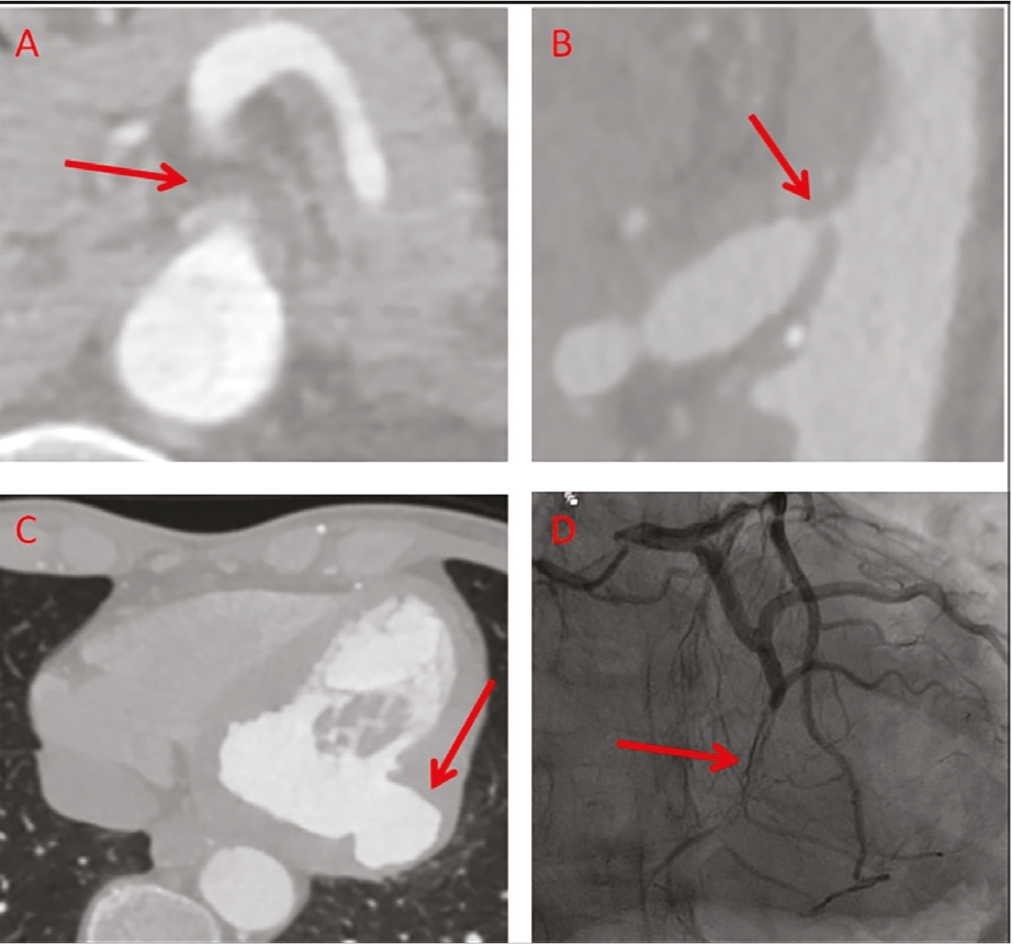
A) Long-segment total occlusion in the proximal part of the SMA, B) short-segment stenosis in the celiac trunk orifice, C) aneurysm on the inferolateral wall at the base of the LV, D) woven coronary artery anomaly involving the distal left circumflex artery
SMA: Superior mesenteric artery
In June 2024, a 6 x 3 cm aneurysm was surgically opened and resected, and the intraluminal thrombus was removed (). Following this, a bypass procedure was performed on the LAD artery using the left internal mammary artery. The cross-clamp time was 20 minutes, and the cardiopulmonary bypass time was 51 minutes. Only 1 unit of fresh frozen plasma was used; no other blood products were required. The patient was discharged from the intensive care unit on the first postoperative day and had no complications during the follow-up period. The second operation, planned 14 days after the first, was successfully performed. Following a median laparotomy, the mesenteric artery and its branches were located using intraoperative ultrasonography and then surgically marked. A bypass was then created between the right common iliac artery (RCIA) and the SMA using a saphenous vein graft harvested from the right leg in a C-loop configuration (). The patient was discharged from the intensive care unit the day after surgery. Upon complete resolution of the patient’s symptoms following the SMA bypass, a multidisciplinary evaluation was conducted to address the CA lesion. It was decided that the patient would undergo regular medical follow-up. After 8 days, the patient was discharged with a prescription for acetylsalicylic acid (100 mg) and experienced no complications. No adverse events occurred during postoperative follow-up. Patient consent was obtained for this case report.
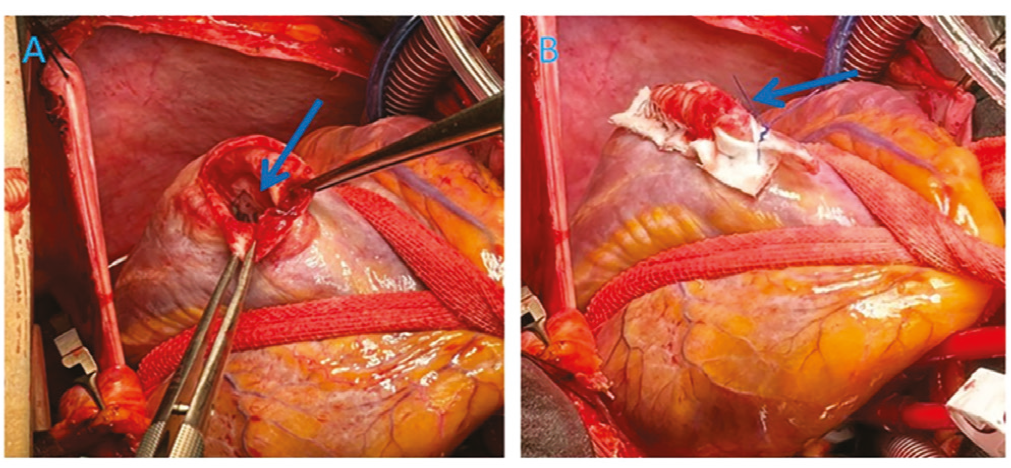
A) Aneurysm that opens linearly and contains thrombus, B) intraoperative view after aneurysm repair
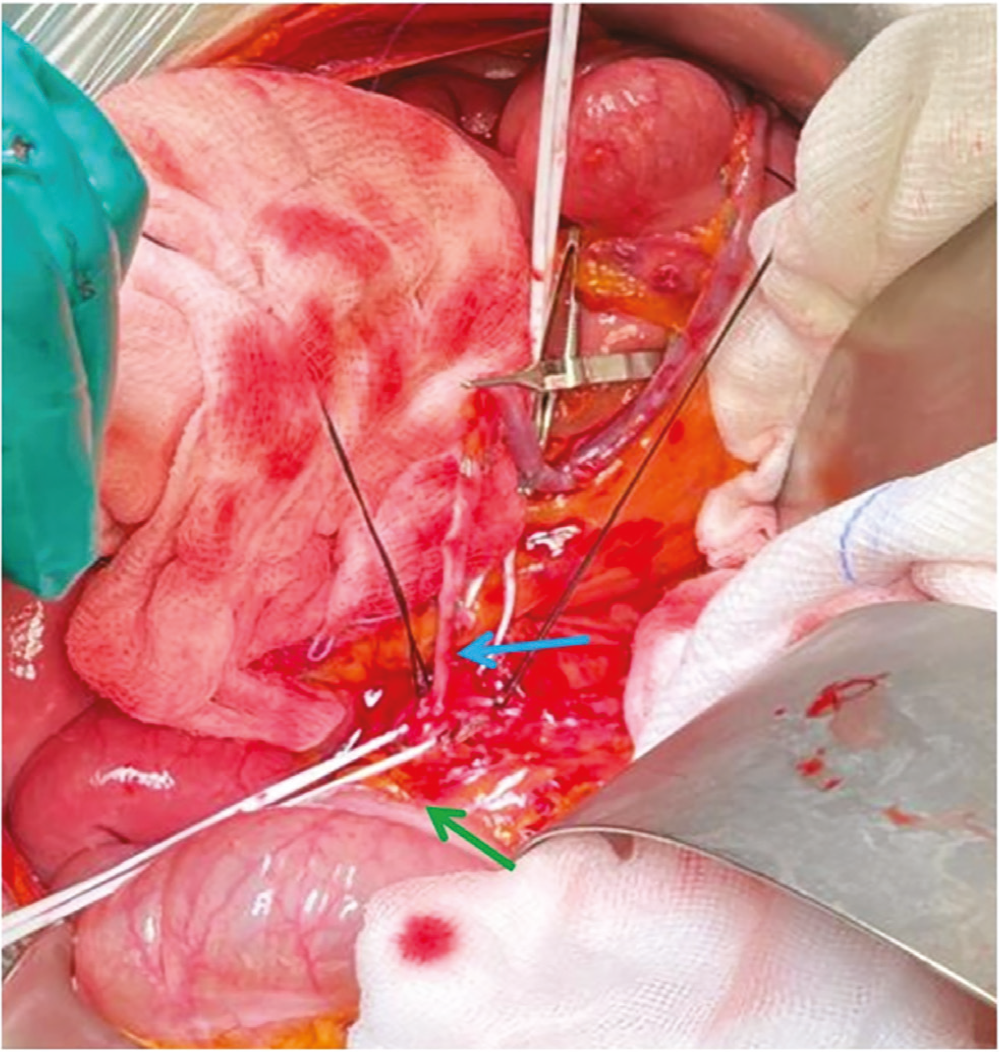
Saphenous vein graft bypassed between the right common iliac artery and superior mesenteric artery. The blue arrow shows the saphenous vein graft. The green arrow shows the superior mesenteric artery where the anastomosis was performed
Discussion
Chronic mesenteric ischemia is a pathology characterized by postprandial abdominal pain lasting about 1 hour and weight loss caused by nausea, vomiting, diarrhea, and fear of food (). The most common cause of mesenteric ischemia is atherosclerosis of the mesenteric arteries. However, it can also occur due to AF and, rarely, due to thrombus formation associated with LV aneurysms, as in this case report (). Ischemic symptoms often occur when two of the three main mesenteric arteries are diseased (). Symptomatic patients should be treated. There is no consensus on treatment options, as various methods have been described.
When deciding on interventions for symptomatic patients, it is important to evaluate patients using a multidisciplinary approach. Both endovascular and open surgical options should be discussed. Currently, endovascular treatment, which involves angioplasty and stenting, has shown high success rates and low mortality rates. It is often considered the first-line treatment (). However, for patients with long segments, consecutive lesions, or complex anatomy who are not suitable for endovascular treatment, open bypass surgery remains a more appropriate treatment option. We present a case of WCA in a patient who developed CMI after an LV aneurysm. To the best of our knowledge, this is the first case report of a patient undergoing bypass surgery for CMI after an LV aneurysm who additionally had a WCA anomaly.
For patients planning to undergo bypass surgery, the target vessels must first be identified. The primary target for revascularization is the SMA. Revascularization of the CA or inferior mesenteric artery may also be considered in patients who are not suitable for SMA revascularization. SMA revascularization alone has been associated with acceptable mortality rates and survival outcomes. Additionally, SMA bypass alone has been shown to be as successful as multivessel bypass in treating bowel ischemia (). It was reported that a permanent improvement in symptoms was achieved in 73% of patients with CMI due to a single MAS who underwent CA or SMA revascularization (). In our case, we planned surgery because the lesion in the SMA involved a long segment and was completely occluded, making it unsuitable for endovascular treatment. We decided to place a stent in the CA because the lesion was short-segment, making it more suitable for endovascular treatment. Since the primary target vessel for bowel ischemia was the SMA, we performed an SMA bypass first. To minimize surgical risk, we initially planned to stent the CA after the operation. Although the patient’s chronic abdominal pain had completely resolved after the operation, we decided to continue medical treatment for the time being.
Various bypass methods have been described in the literature, with antegrade and retrograde approaches commonly used. In an antegrade bypass, the proximal portion of the graft is connected to the distal thoracic aorta or to the proximal abdominal aorta. In retrograde bypass, the distal abdominal aorta, a previous aortic graft, or the iliac arteries are often employed (). Although the absence of aortic clamping during retrograde bypass is an advantage, the procedure is usually performed in a C-loop configuration; therefore, avoiding angulation and kinking of the graft is important. We used the retrograde bypass technique with a C-loop configuration to minimize the risks associated with aortic clamping. Despite only an SMA bypass being performed, all of the patient’s symptoms were fully resolved, and no further interventions were necessary.
One of the most important aspects of studying this disease is investigating its etiology. While CMI is typically caused by atherosclerosis, it can also result from an LV aneurysm, as seen in this case. Despite reporting no cardiac symptoms, the patient was found to have an LV aneurysm on routine preoperative screening and a lesion in the LAD on subsequent CAG. As a result, the patient required cardiac surgery prior to the SMA bypass. Screening patients with CMI for potential cardiac issues could be beneficial. This case report, detailing the first SMA bypass performed after an LV aneurysm, will contribute significantly to the existing literature.
Another important aspect of this case is the presence of a rare anomaly, WCA. Woven coronary artery is a sporadic congenital anomaly in which the coronary artery divides into thin channels and subsequently re-enters the distal lumen. This condition is typically considered benign and often asymptomatic (). We did not plan any intervention because the patient was asymptomatic.
Conclusion
Although endovascular methods are currently the preferred treatment for CMI, open surgical options should be considered for symptomatic patients for whom endovascular treatment is not suitable. Retrograde bypass can be successfully performed through the RCIA. CMI rarely develops as a result of a LV aneurysm; therefore, patients presenting with CMI should undergo a detailed cardiac evaluation.
Ethics
Informed Consent: Patient consent was obtained for this case report.
Footnotes
Authorship Contributions
Surgical and Medical Practices: B.E.Y., K.E., Concept: O.F.B., Design: O.F.B., B.E.Y., K.E., Data Collection or Processing: O.F.B., B.E.Y., K.E., Analysis or Interpretation: O.F.B., B.E.Y., K.E., Literature Search: O.F.B., Writing: O.F.B.
Conflict of Interest
No conflict of interest were declared by the authors.
Financial Disclosure
The authors declared that this study received no financial support.
References
Zafarghandi MR, Samimiat A, Nikraftar P, Sadeghi A, Pourazari P, Shokri A. Aortic reimplantation of the superior mesenteric artery (SMA) for SMA stenosis in a previously stented patient: new technique and a case report. Int J Surg Case Rep. 2024;115:109170.
Geng B, Menth M, Widmer L, Egger B, Psathas E. Retrograde mesenteric perfusion from the deep femoral artery in a patient with a recurrent anastomotic aneurysm in the groin: a case report. Front Surg. 2023;10:1208871.
Jun HJ. Isolated bypass to the superior mesenteric artery for chronic mesenteric ischemia. Korean J Thorac Cardiovasc Surg. 2013;46:146-9.
Gentile AT, Moneta GL, Taylor LM Jr, Park TC, McConnell DB, Porter JM. Isolated bypass to the superior mesenteric artery for intestinal ischemia. Arch Surg. 1994;129:926-31; discussion 931-2.
van Dijk LJD, Moons LMG, van Noord D, et al. Persistent symptom relief after revascularization in patients with single-artery chronic mesenteric ischemia. J Vasc Surg. 2018;68:779-85.
Björck M, Koelemay M, Acosta S, et al. Editor’s choice - management of the diseases of mesenteric arteries and veins: clinical practice Guidelines of the European Society of Vascular Surgery (ESVS). Eur J Vasc Endovasc Surg. 2017;53:460-510.
Ayhan S, Ozturk S, Tekelioglu UY, Ocak T. Woven coronary artery anomaly associated with acute coronary syndrome. Int J Angiol. 2013;22:55-8.